

Harvest at $6.53 a gallon
It is late September, and Iowa is bringing in the corn. The combine, the tractor, the truck to the silo: everything runs on diesel. A gallon of diesel in the US (3.8 litres) now costs an average of $6.53, a record. A year ago it cost $3.75. The price has jumped 74% in twelve months, right in the middle of the harvest and five weeks before the midterm elections on 3 November.
On 22 September Donald Trump offered a solution that looks obvious to anyone filling a tank: “I’ve said let’s not send out the diesel.” America, he added, makes a lot of diesel. On Sunday, 27 September, he said he was looking at a ban “very seriously” and added: “we may do it”.
At first glance the arithmetic is simple. America exports huge volumes of diesel. Keep it at home, and there is more to go around, so the price falls.
But a refinery is not a tap you turn on and off at will. It is more like a river. The ban is a wall built downstream. For the first few weeks the water rises behind the wall and diesel really does get cheaper. Then the reservoir fills. To keep it from overflowing, you have to cut the flow upstream, at the source. And that source does not carry only diesel. It also carries the gasoline for cars and the fuel for planes.
This article follows the river: from the American refinery, through crude oil prices, to the European haulier.
One week, three directions
The last seven days show how unsettled things are.
On 22 September Trump said he backed limiting exports, and Treasury Secretary Scott Bessent confirmed the administration was examining whether a full or partial ban was possible. The next day Politico reported that a 90-day ban was being prepared, and shares in Valero, Marathon Petroleum and Phillips 66 fell. Energy Secretary Chris Wright pushed back at once. Under a full ban, he argued, refineries would process less and gasoline would get more expensive. Instead of a ban, he opened talks with refiners about cutting exports voluntarily. On 25 September Bloomberg reported that the White House had assured Senator Ted Cruz there would be no full ban.
On 27 September Trump changed direction again. According to Bloomberg, National Economic Council director Kevin Hassett, Bessent and Trade Representative Jamieson Greer spent the past week analysing what a short-term ban would do. The oil companies are proposing something else: a temporary suspension of the federal excise tax on diesel.
So far there is no signed order and no regulation. There is a president who wants a ban, an energy secretary who opposes it, and a market that is already starting to price it in.
How America became the world’s filling station
To see how much is at stake, we need to go back.
In 1975 the US exported an average of about 1,000 barrels a day of diesel and other middle distillates (a barrel is 159 litres). That is a rounding error, not a market. The country imported oil, its own output was falling, and its refineries worked for the home market.
Exports began to climb in earnest around 2008. By 2012 they had passed a million barrels a day. In 2025 they averaged 1.25 million barrels a day, 1,250 times the 1975 level.
Then came 2026. The war with Iran began on 28 February, and the Strait of Hormuz is still almost closed. From mid-July Russia dropped out too: after Ukrainian strikes on its refineries, it stopped exporting fuel. American refineries were left as the last large supplier the world could count on.
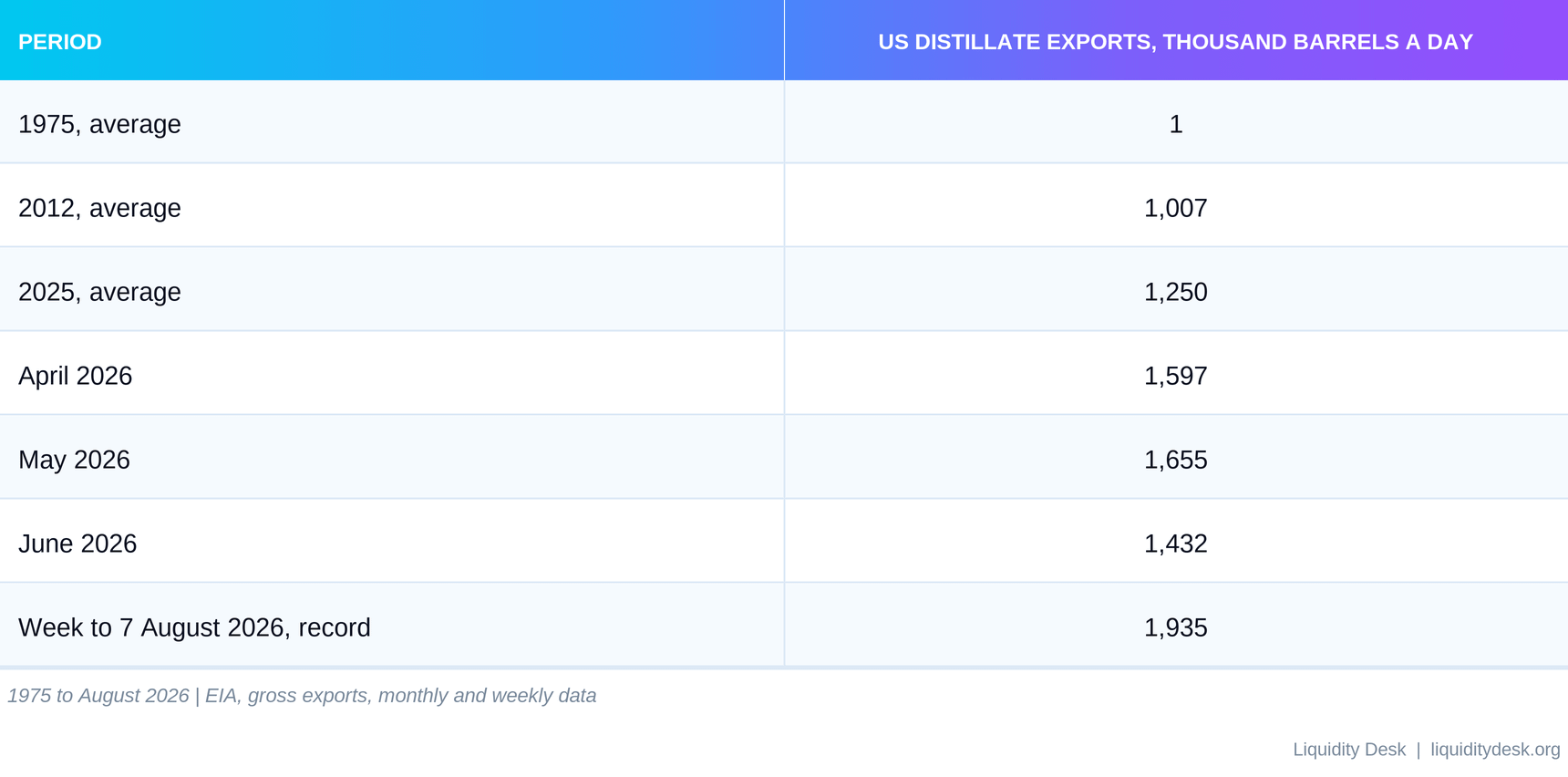
One clarification. These are gross exports. Net exports (exports minus imports) are smaller, but even so this is a volume the country cannot burn through on its own in a few weeks.
1975: the same idea, the other end of the pipe
Today’s situation is most often compared with the law of 1975. After the Arab oil embargo, Congress passed the Energy Policy and Conservation Act (EPCA), which required the president to ban exports of crude oil produced in the US. The ban was lifted only in December 2015.
The Congressional Research Service stresses one important detail. Finished fuels, including gasoline and diesel, were never covered by it.
A common simplification needs correcting here. The 1975 ban did not keep American oil cheap for forty years. Most of the time it had no real effect, because the US was producing less and importing more. There was nothing to export. The ban started to bite only around 2011, when the shale boom flooded the country with light crude. Domestic prices then fell almost $30 a barrel below international ones. (Part of that gap in 2011-2013 also came from a lack of pipelines from the oil hub at Cushing, Oklahoma, to the coast, not from the ban alone.)
In exactly those years American refiners found themselves in a very comfortable position. They bought cheap local crude and sold diesel freely at world prices. Diesel exports had already started rising in 2008, but this is when they accelerated: from about 650,000 barrels a day in 2010 to over a million in 2012.
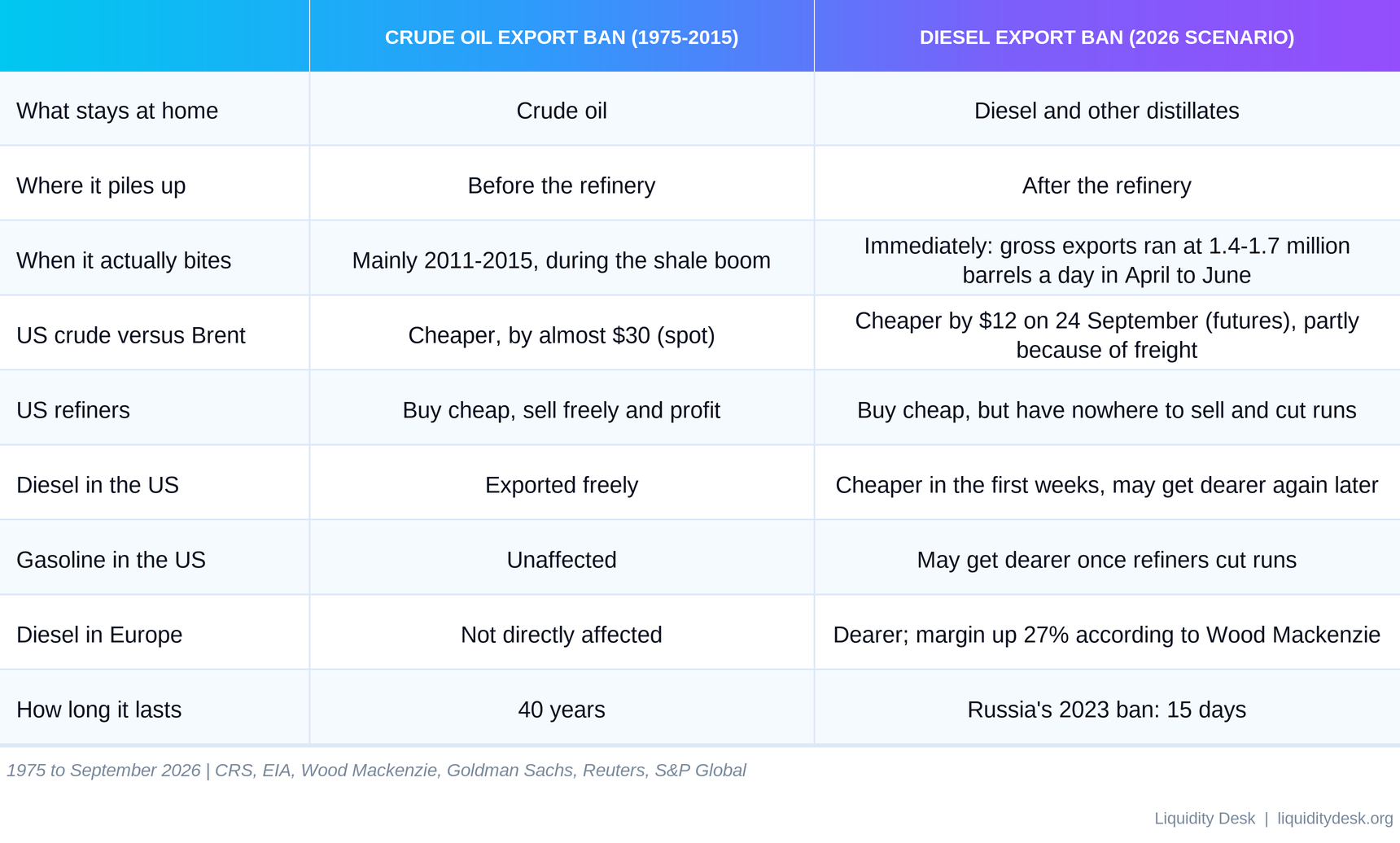
That is the irony. The 1975 law held back the raw material before the refinery and indirectly sped up the growth of the world’s biggest diesel export machine. A 2026 ban would hold back the finished product after the refinery and block the outlet of that same machine.
The idea is the same, “keep it in the country”. Applied at the two ends of the pipe, it produces opposite results. Hold back the raw material, and the refinery gets cheap crude and profits. Hold back the product, and the refinery has nowhere to sell and must cut output.
The real precedent: Russia, 2023
There is in fact a much closer example, and it is recent.
On 21 September 2023 Russia, at the time the world’s largest seaborne exporter of diesel, banned almost all exports of diesel and gasoline to bring prices down at home. The measure threatened to remove about a million barrels of diesel a day from the world market.
The ban lasted 15 days. On 6 October the government allowed diesel that reaches the ports by pipeline to be exported again, provided producers sold at least half of their output at home. First Deputy Energy Minister Pavel Sorokin explained why: refinery tanks were full, and processing was about to fall.
There is a second lesson. ICE Gasoil, the European benchmark for diesel, rose 4.5% on the day of the ban, but only a week later it was almost back to its pre-ban level. From the start the market assumed the ban would not last. It reacted to how long the ban was expected to run, not to the headlines.
How the reservoir fills
First, diesel gets cheaper. When exports stop, diesel that was meant to leave by tanker stays on the Gulf Coast. There is more of it at home and the price falls. According to Goldman Sachs, as long as there is room in the tanks, each week of a ban would lower the average pump price by about 25 cents a gallon, roughly 4% of the current $6.50. That is why the measure appeals to politicians, and the effect is real.
Then the tanks fill. This is the clock that everything depends on. Wood Mackenzie estimates that under a ban about 700,000 barrels a day of surplus diesel would go into storage. The tanks around the Gulf of Mexico (known as PADD 3, where most export-oriented refineries sit) would fill in just over a month, and those in the rest of the country after roughly five more weeks. Goldman gives a longer window: all US diesel storage would theoretically fill in 9-10 weeks if exports fell by 1.6 million barrels a day. The difference comes mainly from whether one looks only at the Gulf Coast or at the whole country. The conclusion is the same: we are talking about weeks, not months.
Finally, the source is shut. A refinery cannot stop making diesel and carry on making gasoline. One barrel of crude yields gasoline, diesel, jet fuel, propane and fuel oil all at once. The proportions can be shifted somewhat, but not reversed. Once diesel has nowhere to go, the refinery has to process less crude overall.
According to Wood Mackenzie, to keep storage from overflowing, American refiners would have to process more than 2 million barrels a day less crude. That is about 12% of all refining in the country. (The full, paid report puts the minimum estimate at 2.7 million barrels a day.)
Less crude processed also means less gasoline. Goldman calculates that once diesel storage is full, each additional week of a ban would raise the gasoline price by about 30 cents a gallon. At the current price of around $4.48, that is close to 7% a week. Wood Mackenzie reaches the same point by another route: the US would have to import more gasoline, and at a higher price.
Compare the two numbers. While there is room in the tanks, diesel gets about 4% cheaper each week. Once the room runs out, gasoline gets about 7% dearer each week. And in America there are far more gasoline cars than diesel trucks. That is the argument Chris Wright is using against his own president. Trump himself concedes the point: a ban “can often times lead to a little bit of an increase on gasoline for cars”. He says he may do it anyway.
What crude oil is already showing
Brent is the international benchmark for crude oil prices, and WTI is the American one. WTI is usually a few dollars cheaper. On 24 September, during trading, the gap reached $12.02 a barrel, the widest since 6 May.
The logic runs like this. If American refineries process 2 million barrels a day less, they also buy less crude. More oil stays in the country without a buyer, and WTI gets cheaper relative to Brent. Wood Mackenzie adds that the Gulf Coast region imports less than 2 million barrels of crude a day. With a cut of that size, America would have to do more than stop importing. It would also have to export more of its own crude.
In other words, the market is doing almost exactly what it did under the old ban: pushing the price of American crude down relative to the world price. Only the reason is reversed. Then it was the raw material that was trapped. Now it would be the finished product.
Here, though, we need to be precise, because it is tempting to put the whole move down to diesel. The gap is also widening for a separate, independent reason: shipping has become more expensive. A large tanker of crude from the Gulf of Mexico to Asia now costs about $50 million, against $16 million before the war with Iran. According to Bob Yawger of Mizuho, American crude now has to be about $8 cheaper than Brent to cover the freight, double the usual $4. So part of that $12 is down to tankers, not diesel. The signal is real, but it is not clean.
Europe is downstream
If America builds the wall, Europe is where the water stops arriving.
After the EU stopped importing Russian diesel, Europe replaced much of it with American supply. According to Wood Mackenzie, almost half of US diesel exports are going to Europe in September 2026, against an average of 30% in 2025. European refineries are already running at full capacity. There is no spare.
If the ban is introduced, Wood Mackenzie expects the diesel margin in Northwest Europe to jump by 27%. (The margin is the difference between the price of diesel and the price of the crude it is made from. The bigger it is, the more the refinery earns and the sharper the shortage.) Goldman calculates that each week of a ban would raise the wholesale price of diesel in Europe by about $3 a barrel, or just under 2%. If European governments release their strategic reserves onto the market, that would offset about half.
The market reacted to the mere discussion. According to Bloomberg, on 23 September American diesel on the NYMEX exchange fell against European diesel far enough that its premium became the smallest since the end of April, and the one-day move was the largest since 2022. American diesel is already getting cheaper relative to European diesel, without any decision at all.
Who would fill the gap? According to Wood Mackenzie, only China has significant spare capacity, about 300,000 barrels a day. Russia could add about 190,000, but it is restricting its own exports. Analysts note drily that China may well decide that helping is not in its interest.
This is also the link to the wider economy, and the reason this story belongs in Liquidity Desk rather than only in the energy news. Diesel moves trucks, trains, ships and farm machinery. Expensive diesel does not stay at the filling station. It works its way into the price of everything that gets transported. For the European Central Bank, which is already watching energy costs rise because of the war with Iran, an American ban would mean imported inflation. And it would not come from the market. It would come from a decision in Washington.
The two cases side by side
What weakens the argument
The argument so far is strong, but there are five things that could reverse it or soften it.
The ban may never happen. Goldman considers the scenario “very plausible”, but explicitly not the most likely one. The administration has softer options too: voluntary limits by the refiners, quotas, or a temporary suspension of the federal excise tax. Under all of them, less diesel leaves the market, or exports are not touched at all. The full chain of consequences applies only to a complete ban.
A partial limit could be tuned so that the reservoir never fills. If exports are cut only by as much as the country can absorb during the harvest and the start of the heating season, the tanks may not fill. Wood Mackenzie believes the East Coast (PADD 1), which is normally short of diesel, could take some of the surplus. That gives you the first phase without the third. That is probably the idea behind the “voluntary” cuts.
Refiners have some room to manoeuvre. They can make more jet fuel and gasoline at the expense of diesel. Under a full ban this does not solve the problem, but it delays the moment the tanks fill, and with it the cuts.
The election calendar may matter more than the physics. The election is on 3 November. If a ban starts in early October and Wood Mackenzie is right that storage around the Gulf of Mexico will fill in just over a month, gasoline will start getting dearer around mid-November. In other words, cheap diesel arrives before the election and expensive gasoline after it. We are not claiming this is the aim. But investors should keep in mind that a measure can be bad economics and sound politics at the same time. And the Russian example shows that domestic prices really do fall, even if the ban lasts only two weeks.
Perhaps the threat itself is the point. Bloomberg commentator Javier Blas has offered a more cynical explanation. In his view, the talk of a ban is a message to the EU and the UK: release your own reserves, stop bidding prices up while you refill them, and lean on Kyiv over the strikes on Russian refineries. If so, the talk alone may do the job without any real ban. The European Commission responded just a day later with a warning that any disruption would hurt both sides.
And one note on method: the gap between Brent and WTI is not a reliable gauge of the risk of a ban, because, as we saw, much of it is down to freight.
What to watch
If the ban is introduced, four markets will show very quickly whether America is getting cheaper diesel or its refineries are clogging up.
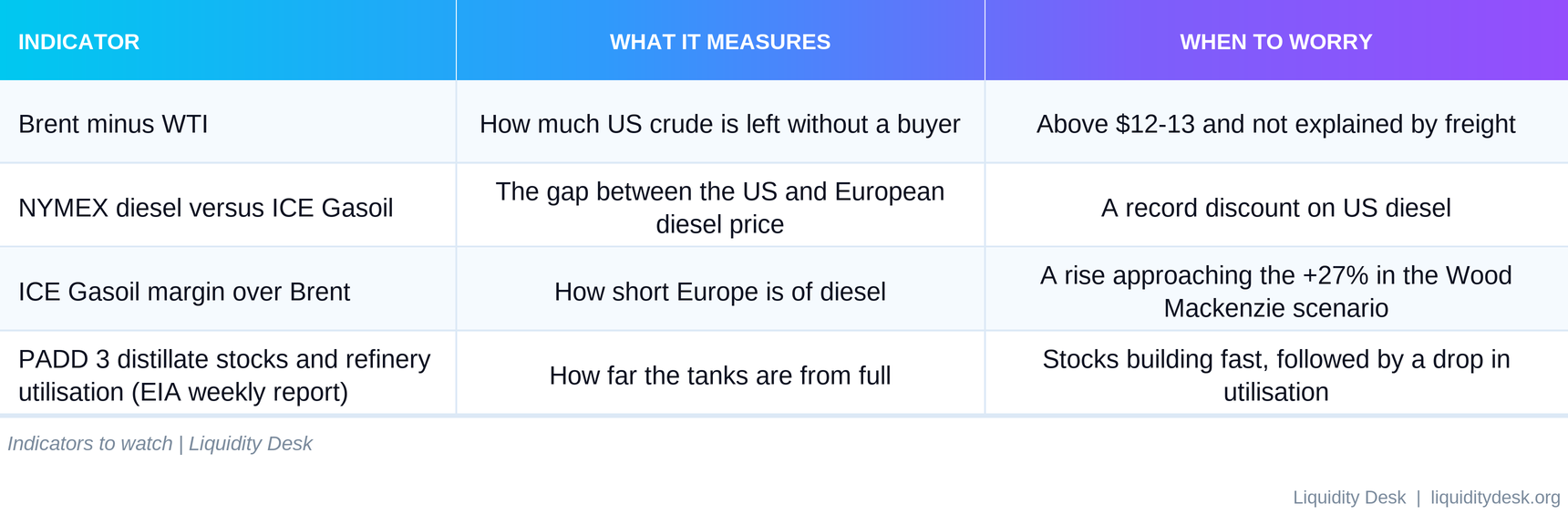
It is also worth adding RBOB gasoline futures, to see whether gasoline starts getting dearer while diesel gets cheaper, and the shares of American refiners (Valero, Marathon Petroleum, Phillips 66) against their European peers. They were the fastest to react to the news on 23 September.
For now the strongest signal is that the market is moving ahead of the decision. American diesel has fallen against European diesel, WTI has moved away from Brent, and refiners’ shares have dropped. The market is already building the dam on paper.
Conclusion
A ban on diesel exports looks like a trade measure. In fact it interferes with how refineries work, and through them with the whole chain: from gasoline in America, through the gap between the two crude benchmarks, to prices and inflation in Europe.
The 1975 law held back the raw material and indirectly sped up the growth of the world’s biggest diesel export machine. A ban in 2026 would hold back the finished product and block the outlet of the same machine. Russia tried exactly that in 2023 and gave up after 15 days.
A reservoir can hold the water back for a few weeks. The river does not stop.
Sources
Axios, “Trump backs diesel exports ban, marking a shift for administration”, 22 September 2026: https://www.axios.com/2026/09/22/trump-diesel-exports-ban
CNBC, “Oil industry warns a diesel export ban will raise fuel prices as Trump weighs restrictions”, 23 September 2026: https://www.cnbc.com/2026/09/23/trump-diesel-export-ban-gas-prices.html
Bloomberg, “Trump Says He’s ‘Very Seriously’ Looking at Diesel Export Ban”, 27 September 2026: https://www.bloomberg.com/news/articles/2026-09-27/trump-says-he-s-very-seriously-looking-at-diesel-export-ban
CNBC, “Trump ‘very seriously’ considering diesel export ban as global supply crunch worsens”, 28 September 2026: https://www.cnbc.com/2026/09/28/diesel-oil-trump-export-ban-fuel-prices.html
EIA, Gasoline and Diesel Fuel Update, weekly retail prices (diesel and gasoline, week of 21 September 2026): https://www.eia.gov/petroleum/gasdiesel/
EIA, U.S. Exports of Distillate Fuel Oil, monthly data: https://www.eia.gov/dnav/pet/hist/LeafHandler.ashx?n=pet&s=mdiexus2&f=m
EIA, U.S. Exports of Distillate Fuel Oil, annual data: https://www.eia.gov/dnav/pet/hist/LeafHandler.ashx?n=PET&s=MDIEXUS2&f=A
EIA, U.S. Exports of Distillate Fuel Oil, weekly data: https://www.eia.gov/dnav/pet/hist/LeafHandler.ashx?n=PET&s=WDIEXUS2&f=W
EIA, Brent and WTI spot prices, daily data: https://www.eia.gov/dnav/pet/pet_pri_spt_s1_d.htm
EIA, Refiner and Blender Net Input, weekly data: https://www.eia.gov/dnav/pet/hist/LeafHandler.ashx?n=PET&s=WGIRIUS2&f=W
Congressional Research Service, R43442, “U.S. Crude Oil Export Policy: Background and Considerations”: https://www.everycrsreport.com/reports/R43442.html
Congressional Research Service, R44403, “Crude Oil Exports and Related Provisions in P.L. 114-113: In Brief”, 22 February 2016: https://www.everycrsreport.com/files/20160222_R44403_3c9330ccdf269b7d812ef9985476c1cb86406a77.html
Wood Mackenzie, press release, 24 September 2026: https://www.woodmac.com/press-releases/a-us-diesel-export-ban-would-trigger-global-stock-drawdowns-cut-us-refinery-utilisation-and-risk-driving-gasoline-prices-higher
Wood Mackenzie, “US diesel export ban” report (summary): https://www.woodmac.com/reports/refining-and-oil-products-us-diesel-export-ban-150506792
Reuters via US News, “Talk of US Export Ban on Diesel Deepens US Crude Futures’ Discount to Global Benchmark”, 25 September 2026: https://money.usnews.com/investing/news/articles/2026-09-25/analysis-talk-of-us-export-ban-on-diesel-deepens-us-crude-futures-discount-to-global-benchmark
Goldman Sachs note of 26 September 2026, via ANI: https://www.aninews.in/news/business/us-diesel-export-curbs-could-lower-diesel-prices-initially-lift-gasoline-prices-later-report20260927182117/
Goldman Sachs note of 26 September 2026, via investingLive: https://investinglive.com/commodities/goldman-us-diesel-export-ban-would-cut-us-prices-about-4-lift-european-cost-d-uh/
Bloomberg, “Europe’s Diesel Prices Race Ahead of US on Export-Ban Risks”, 24 September 2026: https://www.bloomberg.com/news/articles/2026-09-24/europe-s-diesel-prices-race-ahead-of-us-on-export-ban-risks
S&P Global, “Russia eases diesel export ban, restores refiners’ subsidy as storage fills”, 6 October 2023: https://www.spglobal.com/commodity-insights/en/news-research/latest-news/crude-oil/100623-russia-eases-diesel-export-ban-restores-refiners-subsidy-as-storage-fills
S&P Global, “Russia warns over futile hopes of a quick end to fuel export ban”, 28 September 2023: https://spglobal.com/commodityinsights/en/market-insights/latest-news/oil/092823-russia-warns-over-futile-hopes-of-a-quick-end-to-fuel-export-ban
Reuters via gCaptain, “Russia Lifts Ban on Most Diesel Exports”, 6 October 2023: https://gcaptain.com/russia-lifts-ban-on-most-diesel-exports
DTN, “ULSD Futures Gain on Russian Export Ban, WTI, Brent Soften”, 21 September 2023: https://www.dtnpf.com/agriculture/web/ag/news/world-policy/article/2023/09/21/wti-slips-usd-gains-ulsd-climbs
The Deep Dive (start of the war with Iran, 28 February 2026): https://thedeepdive.ca/goldman-sachs-models-what-a-us-diesel-export-ban-would-actually-cost/
Bloomberg via The Straits Times, “Trump says he’s ‘very seriously’ looking at diesel export ban”, 28 September 2026: https://www.straitstimes.com/world/united-states/trump-says-hes-very-seriously-looking-at-diesel-export-ban