

Draw the Line
Take a map. Place one finger on the Donbas and another on the Strait of Hormuz. The line between them runs roughly 3,500 kilometers, passing through the Caucasus, the Caspian basin, and the mountains of northwestern Iran. It crosses almost every critical energy corridor in the world.
That line is not an abstraction. It is a front.
For the past several years, analysts and policymakers have treated the war in Ukraine, the tensions in the Persian Gulf, and the broader fragility of the Middle East as separate crises, each with its own logic, its own actors, its own calendar. That framing is increasingly hard to defend. What is emerging along this arc is something more coherent, and more dangerous, than a collection of regional conflicts. It is a single system of instability, and what connects its nodes is not geography alone. It is a shared weapons ecosystem and a network of strategic relationships that spans both theatres.
The Common Denominator
Iran does not fight its wars directly. It fights them through architecture: a network of proxies, weapons transfers, and strategic relationships built over decades. The Houthis in Yemen, Hezbollah in Lebanon, various militia formations in Iraq and Syria. Each operates with degrees of autonomy, but each draws from the same source of materiel, doctrine, and political cover.
What has changed in the past two years is that this network has been visibly connected to the war in Europe. The Shahed-136 drone, originally an Iranian design, became one of Russia’s primary weapons in its campaign against Ukrainian cities and infrastructure. Thousands of them were launched against Kyiv, Kharkiv, Odessa. Ukraine learned to fight them, and in doing so developed something rare: a body of operational knowledge about drone warfare that no NATO military could fully replicate from exercises alone.
This winter, Russia launched over 19,000 drones into Ukraine. The number is not just a statistic. It is a curriculum.
Security as a Commodity
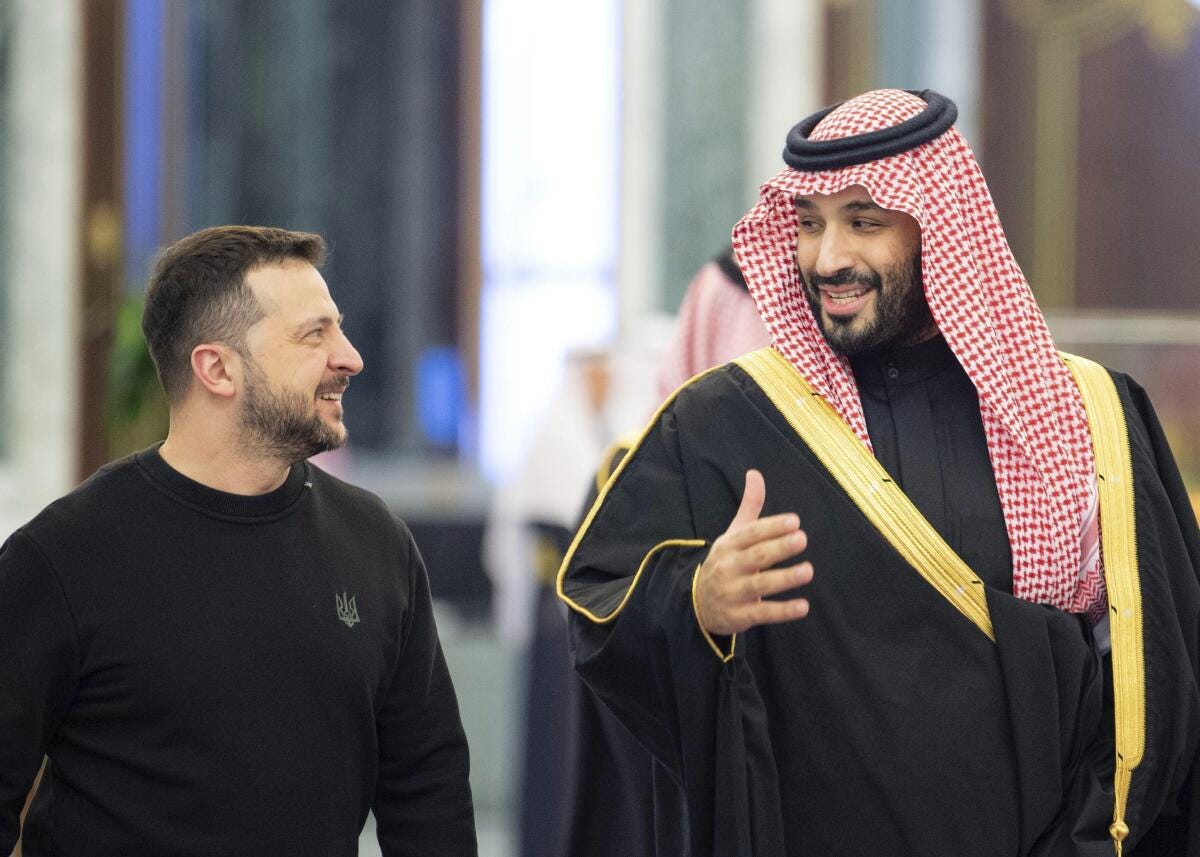
Zelenskyy’s visit to the Gulf last week was described in many outlets as a diplomatic surprise. It was not. It was the logical result of a strategic pivot that Ukraine has been executing for months.
Ukraine signed defence cooperation agreements with Saudi Arabia, the UAE, and Qatar. Over 200 Ukrainian anti-drone experts are deployed across the region. The same Iranian drones that Ukraine has been shooting down over Kyiv are now being fired at Gulf oil infrastructure. Zelenskyy did not need to make a lengthy argument. He simply showed up with something the Gulf states desperately needed and could not easily find elsewhere.
This is a fundamental shift in how Ukraine positions itself internationally. For much of the war, Kyiv was a supplicant, asking for weapons, asking for money, asking for political support. That posture was necessary but limiting. What Zelenskyy has understood, perhaps better than most Western leaders, is that Ukraine now possesses something genuinely scarce: real-world expertise in a form of warfare that the rest of the world is only beginning to face.
He has turned suffering into leverage. That is not cynical. It is statecraft.
The Economics of the Arc
There is a number that explains why Zelenskyy’s Gulf tour mattered more than most diplomatic visits in recent memory. A single Patriot PAC-3 missile costs over three million dollars. A Ukrainian interceptor drone costs between one and two thousand. The ratio is roughly fifteen hundred to one.
That gap would be an interesting footnote in normal times. The Shahed drone it is designed to destroy costs between $25,000 and $40,000. In the first three days of the Iran war, Gulf states fired more than 800 Patriot missiles, more than Ukraine has received across four years of conflict. At that burn rate, the math becomes an emergency.
Ukraine did not invent a better missile. It invented a different logic. Rather than matching expensive threats with expensive responses, Ukrainian manufacturers built interceptors designed to be consumed at scale. The Sting by Wild Hornets, the STRILA by WIY Drones, the Bullet by General Cherry, all cluster between $1,000 and $2,500 per unit. STRILA dropped in price by 31 percent in three months as electronics were localised. Skyfall’s P1-SUN is positioned at around $1,000, with claimed production capacity of 50,000 units per month. Ukraine produced 100,000 interceptor drones in 2025 alone, an eightfold increase over the prior period.
What the Gulf states are buying is not just hardware. They are buying a production doctrine: the idea that air defence can be industrialised at a price point that does not bankrupt the defender.
What the Arc Means
The arc from Ukraine to Hormuz is not just a military reality. It is an economic one.
The Strait of Hormuz handles roughly one fifth of global oil trade. The pipelines running from the Caspian to European and Asian markets cross territory that sits directly within the zone of instability. Ukrainian grain exports, already disrupted by the war, are tied to Black Sea routes that run through geopolitically contested space. Every node along this arc is connected to commodity prices, freight costs, and the inflation dynamics that central banks have spent three years trying to contain.
When analysts speak of stagflation risk, they are usually pointing to some combination of slowing growth and persistent inflation. What the arc provides is a structural mechanism for that combination: supply shocks that are not temporary disruptions but features of a multi-year geopolitical reconfiguration. Energy prices that remain elevated not because of demand but because of risk premiums that the market cannot easily price away.
The MOVE index, which measures bond market volatility, and credit spreads in high-yield debt do not spike because of events. They spike because of systems. What we are watching along this arc is the slow formation of a system.
The Precedent Nobody Is Citing
There is a country that has run this playbook before. Israel has spent decades converting its military experience and technology into diplomatic and economic relationships across the world, including with states that officially did not recognise it. The logic was simple: we have something you need, and geography has given us experience you cannot replicate. Israel sold that experience as intelligence sharing, weapons systems, agricultural technology, cybersecurity.
Ukraine is now operating from the same manual. The product is different but the logic is identical. We have been tested in ways you have not. We have failed, adapted, and survived. That knowledge has value.
The open question is whether Ukraine can institutionalise this. Israel’s model worked in part because the state survived long enough to build durable institutions around its security exports. Ukraine’s ability to do the same depends on outcomes that remain genuinely uncertain. But the direction is clear.
A Front Without a Name
We do not yet have a name for what is forming along this arc. It is not a world war. It is not a cold war in the classical sense. It is something closer to a permanent state of managed instability, in which several major powers and a network of proxies compete across a geography that happens to sit on top of most of the world’s critical energy infrastructure.
The rules of this competition are being written in real time, partly in drone factories in Iran and Russia, partly in Ukrainian interceptor programs, partly in the memoranda of understanding being signed in Jeddah and Abu Dhabi. The outcome will shape energy prices, capital flows, and geopolitical alignments for the next decade.
Draw the line again. The Donbas to Hormuz. It is worth keeping on your wall.