

Liquidity Desk | Education Series
Introduction
Picture this. Late 2020. The pandemic has changed the world, interest rates are at zero, and money is flowing freely. Social media accounts appear with promises like “this stock will do 100x.” A new investor, let’s call him Alex, follows the recommendation. He puts $5,000 into a small biotech company with a “revolutionary technology.” Six months later, the company announces that its clinical trial has failed. The stock drops 85%. Alex loses $4,250. The account that recommended the stock is already promoting the next “100-bagger opportunity.”
Alex is not the exception. He is the rule.
What Is a 100-Bagger and Why Is the Idea So Appealing?
The term comes from Christopher Mayer’s book “100 Baggers: Stocks That Return 100-to-1 and How To Find Them,” published in 2015. Mayer analyzed companies that had done exactly that: 100 times the original investment. Amazon, Monster Beverage, Netflix. Real companies, real numbers.
The idea is mathematically beautiful. $10,000 invested in the right company becomes $1,000,000. Without working more. Without moving. Simply because you chose correctly.
That simplicity is precisely what makes it so dangerous.
Because Mayer’s book is an academic analysis of past events. It does not say “here is how to find the next such company tomorrow.” It says “here is what these companies had in common, looking backwards.” The difference is enormous. But when the same idea reaches social media, the academic nuance disappears. Only the promise remains.

The Graveyard Nobody Shows You
When an account shows you that Amazon returned 100x from 1997 to today, it is technically correct. But it does not show you the other 300 dot-com companies from the same period: Pets.com, Webvan, Kozmo.com, eToys.com. All with equally compelling stories, equally charismatic founders, equally “revolutionary” business models. Most of them do not exist today.
This is survivorship bias. We see only the winners because the losers have disappeared from our field of vision. Nobody makes a YouTube video titled “That Company I Recommended Lost 90% in 18 Months.”
The numbers are merciless. Academic research on the US market shows that approximately 40% of all stocks ever traded on exchanges have lost virtually all their value. Around 64% underperform a simple index fund over their entire life as a public company. The market’s overall return is driven by a small number of exceptional winners, while the majority of stocks simply lose money or go nowhere.
In other words, finding a 100-bagger is not hard. It is a statistical exception in a sea of failures.
And that sea is never shown to you.
Even If You Are Right, Staying Right Is Nearly Impossible
Let’s assume you’ve done the impossible. You’ve researched the company, you understand the business, you buy NVIDIA in 2015 at $5. The right decision, at the right time. Theoretically, by 2023 your position has returned over 100x.
But let’s look at what happened along the way.
In 2018, NVIDIA drops more than 55% in less than three months. The crypto cycle ends, GPU demand collapses, analysts slash price targets across the board. Everything looks logical to sell.
In 2022, the stock falls again, more than 65% from its peak. Interest rates are rising, the tech sector is collapsing, the macro environment is hostile. Again, everything looks logical to sell.
The question is not whether NVIDIA is a good company. The question is: how many people actually bought in 2015 and held without selling even once through those two crashes?
The psychology of loss is well documented. Daniel Kahneman and Amos Tversky showed in their research that the pain of loss is approximately twice as powerful as the pleasure of an equivalent gain. When your position is down 60%, your brain is not calculating future opportunities. It is screaming “save what’s left.”
Most people sell exactly there.
The People Who Actually Held
Now comes the most important question. Who are the people who actually held those positions through every crash and realized the full 100x return?
In the vast majority of cases, they are founders of the company or people extremely close to it. Not retail investors following a social media account.
Bill Gates founded Microsoft and has held shares from the very beginning. He was not buying on a recommendation. He was building the company. When Microsoft fell more than 60% during the dot-com bubble between 2000 and 2002, Gates held. Not because he was psychologically stronger than everyone else, but because his shares were an inseparable part of his identity, the work of his life. It was not simply a position in a portfolio. It was the company he built.
Jeff Bezos is the same story. At Amazon’s IPO in 1997, he owned more than 43% of the company. Amazon fell more than 90% during the dot-com crash between 2000 and 2001. Bezos held, not because he knew something others did not, but because Amazon was his company, his project, his vision. Selling was not an option for the same reason you do not sell your business simply because it goes through a difficult period.
The retail investor following a social media recommendation has none of this. He has a position in a company whose CEO he does not know by face, in an industry he barely understands, with money he worries about every night. When the stock falls 60%, there is neither an emotional nor a rational reason to hold. And he almost never does.
When the Recommender Is the Fraudster
Until now we have been talking about well-intentioned deception. People who believe in the idea but do not understand the mathematics and psychology behind it. But there is another category, darker and more dangerous. The category of people who know exactly what they are doing.
To understand the mechanics, let us go back to the early 2000s. There are many examples we could examine. But one stands out not only for its scale and impact, but because the same individual has repeated the same model twice in a single lifetime. That alone makes it worth studying in detail. MicroStrategy (ticker: MSTR on NASDAQ, today rebranded as Strategy) is a technology company. Its founder and CEO, Michael Saylor, is the face of the new economy. Charismatic, confident, with a vision for the future. The stock rises sharply. Investors believe the story.
The problem is that the story was partly fabricated.
In March 2000, the SEC brought charges against MicroStrategy and three of its executive officers, including Saylor personally, for manipulating the company’s financial results over a period of two years. Revenues were inflated, profits were distorted. When the truth came out on March 20, 2000, the stock fell 62% in a single day. Within approximately one month, the total decline from the peak exceeded 90%. This is considered one of the key events marking the end of the dot-com bubble. More than twenty class action securities fraud lawsuits were subsequently filed against the company. Saylor settled with the SEC without admitting wrongdoing, paying personally over $8.6 million, of which $8.3 million was disgorgement of ill-gotten gains and $350,000 was a civil penalty.
But the story does not stop there.
Between 2005 and 2021, while living in a 650 square meter luxury penthouse in Georgetown, Washington D.C., with yachts docked on the Potomac River, Saylor filed tax returns in states with lower taxes, first Virginia, then Florida, which has no income tax at all. The scheme was elaborate: his company issued false W-2 forms, employees maintained detailed logs of his location showing he was in DC more than 200 days per year. Saylor not only operated the scheme, but openly bragged about it to friends, telling them that “anyone who pays taxes in DC is stupid.” In 2024, he settled the case for $40 million, the largest income tax recovery in Washington D.C. history.
This same man is today one of the most vocal Bitcoin supporters, appearing at conferences, on podcasts and social media with messianic confidence. His company, rebranded as Strategy, has purchased over 500,000 Bitcoin using corporate funds. He is presented as a symbol of “long-term thinking” and “financial freedom.”
Not a Single Dollar of His Own Money
But there is one detail in Saylor’s story that is rarely mentioned and that reveals the mechanics in full light.
Saylor has not personally invested a single dollar of his own money into Bitcoin through this scheme. Not one.
The mechanics work as follows. Strategy issues new shares, diluting the stakes of existing shareholders, and uses the proceeds from those sales to buy Bitcoin. In 2024 and 2025 alone, the company raised over $25 billion this way, through equity offerings, convertible notes, and preferred stock. It became the most active stock issuer in the entire US market during that period.
In plain language: people who believe the story buy shares. With the money from those sales, Bitcoin is purchased. The price of Bitcoin rises partly because Strategy is buying so aggressively. This attracts new buyers for the shares. The cycle closes.
The deceived themselves finance the purchases. The purchases themselves sustain the illusion. The illusion attracts new buyers.
When Strategy’s stock fell more than 70% from its late-2024 peak to early 2026, while Bitcoin moved far more moderately, the thesis of “Bitcoin per share” was exposed as a mathematical fiction. But Saylor continued appearing at conferences with messianic confidence, announcing new purchases every week.
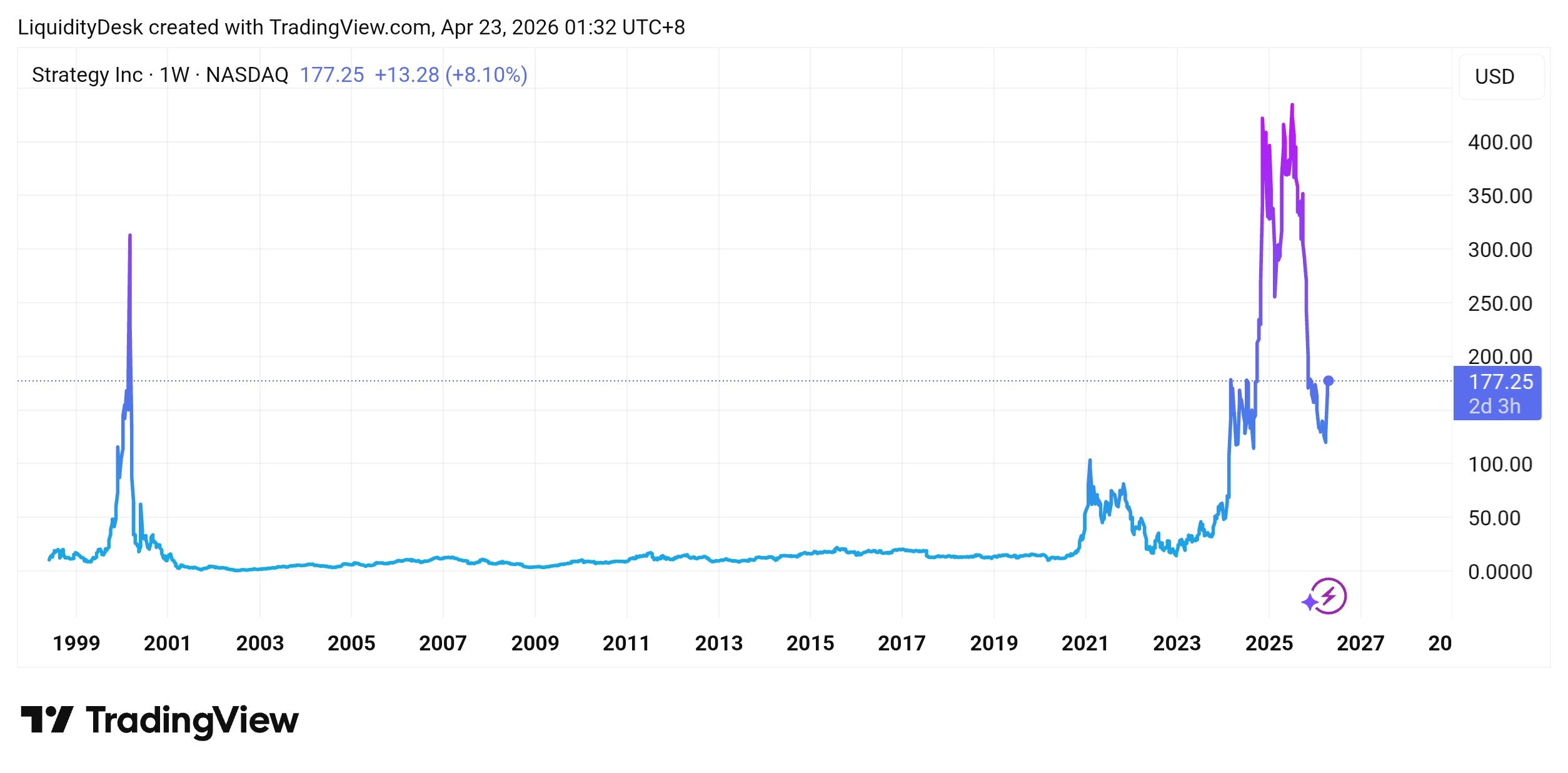
MSTR, 1999 to 2026. Two peaks, two crashes, one name. The instruments changed. The model did not.
The scheme of 2000 used inflated accounting results. The scheme of 2024 uses inflated faith in an asset. The instruments are different. The model is identical.
And the model is identical across all 100-bagger accounts, even the well-intentioned ones. The business model is not finding good companies. The business model is the audience. Subscriptions, courses, affiliate programs, sponsorships. The more people follow the recommendations, the more influence and revenue grow. Whether the recommendations work is irrelevant to their business model, as long as the stories sound compelling.
Investing or Gambling?
But there is something deeper that is rarely discussed. The very model of searching for companies with 100x potential is by its nature closer to gambling than to investing. Because in most cases these companies are at the very beginning of their existence. They have no proven history of profitability. They have no tested business model. They have only a story, a promise, and enthusiasm. That is a bet on a future that may never arrive.
And even if we find the right company and realize a profit, the psychology of gambling kicks in immediately. We will look for the next one. Then another. Every success convinces us that we have a “feel” for these companies. Every loss we explain as bad luck or bad timing, not as a fundamental problem with the strategy. Exactly like in a casino. And exactly like in a casino, one iron rule applies: sooner or later, the house always wins. The market for high-risk bets is structured so that most players lose in the long run, regardless of their short-term successes. The only guaranteed profit goes to those who sell the tickets.
The Compounding Effect
Warren Buffett has said something simple and profound. Rule number one: never lose money. Rule number two: never forget rule number one. This is not just a quote. It is a mathematical fact.
If you have $10,000 and lose 50%, you have $5,000 left. To return to breakeven you need to earn 100%, not 50%. Losses and gains are not symmetrical. Every large loss requires a disproportionately large subsequent gain just to get back to zero. And while you try to get back to zero, time passes. The years in which compounding could have been working for you instead of against you.
A person with $10,000 invested in a simple index fund for 30 years at the historical average return of 10% per year reaches approximately $175,000. No stress. No panic selling.
A person who spent the same 30 years chasing 100-baggers, with the inevitable large losses along the way and the disrupted compounding effect, very rarely gets further than the first.
Conclusion: It Is Not About the Company. It Is About the Mathematics.
This article is not an argument against investing in small companies. Small companies can be exceptional investments. Some of them will genuinely do 10x, 20x, even 100x. History proves it.
But there is an enormous difference between the informed investor who allocates a small, predetermined portion of their portfolio to such bets, with full awareness that most will fail, and the novice investor who follows a messia and puts a significant portion of their savings into “the next big company.”
The first understands the mathematics. The second is buying a story.
Survivorship bias is merciless precisely because it is invisible. You do not see the graveyard. You see only the winners, because the losers have disappeared from your screen, from the account’s memory, from the history of recommendations. Nobody comes back six months later to say “that company I recommended lost 90%.” Algorithms do not amplify losses. They amplify wins.
The people who actually held 100-baggers to the end are founders and insiders. They were not following a recommendation. They were building something. The difference is not in the information. It is in the psychological and emotional connection to the company, which the retail investor by definition cannot possess.
The people who profit from 100-bagger accounts are in most cases not their followers. They are the accounts themselves, through subscriptions, courses, and sponsorships. Their business model is the audience, not the portfolio.
And when behind these accounts stands a history like Michael Saylor’s, with two separate settled fraud cases within a single human generation, the question is not whether to trust the recommendation. The question is why you are listening at all.
The best thing you can do as a novice investor is simultaneously the most boring. Understand what you are buying. Invest only what you can afford to lose entirely in risky bets. Protect your compounding by preserving your core capital. And when someone promises you 100x, first ask them how many times they have shown you their losses.
The answer will tell you everything.
Good article. I think it’s not intuitive that 100 times your money over 25 years is ~20% CAGR, which is incredibly high and basically Buffett level of compounding. You have to find a business that is growing cash flow per share at that level AND can sustain those levels of growth for a long time, which is extremely rare. On top of that, the market is good at seeing this and often you have to pay a high price for those cash flows to start, which you have to overcome with the growth. And competition also sees this and wants a piece of the action, trying to erode your company’s advantage. I had an old boss who would say, in effect, the mistakes I have made are not because I paid too much, they were because cash flows went down. I know that seems simple, but I personally have never bought a business believing cash flows will decline over the next 5-10 years, although from time to time it happens and my position gets punished. One last thing, I don’t think many people who seek 100-baggers are thinking about 25+ years and the economics to get there. They are gambling and the urge will never go away.
Perseverance sounds right, but without conviction and understanding, most fold after 60% drawdowns, before compounding has a chance to build.