Macro Pulse: Eurozone ECB Decision and Consumer Confidence - July 2026
The ECB Paused. It Did Not Turn Dovish.
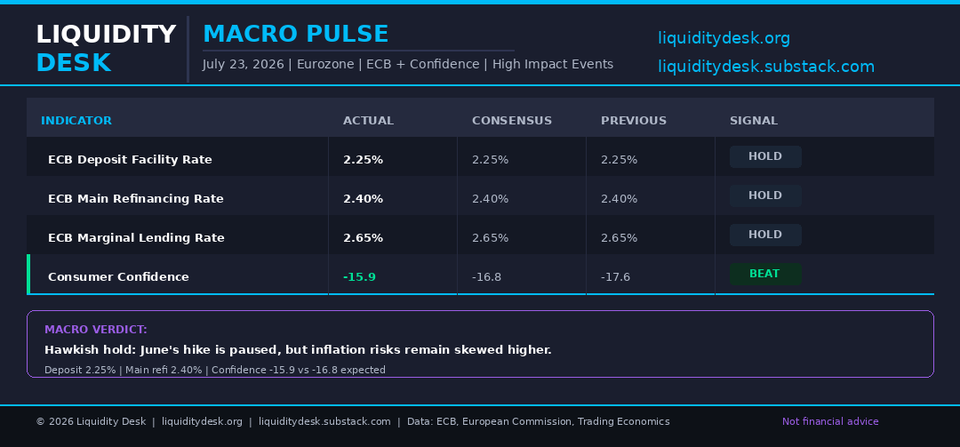
The headline from the European Central Bank's July meeting is simple. All three policy rates were left unchanged, exactly as expected. The deposit facility remains at 2.25%, the main refinancing rate at 2.40%, and the marginal lending facility at 2.65%.
The market could read that as the end of the ECB's renewed tightening cycle. The details argue for more caution.
The July decision follows the 25 basis point increase delivered in June. The ECB did not reverse that move, soften its inflation language, or open the door to rate cuts. It described the energy outlook as highly volatile, close to the June baseline, and still well above the levels seen before the Middle East conflict. It also stressed that the full inflationary effect of the shock has not yet passed through the economy.
At the same time, euro-area consumer confidence improved more than expected. The index rose to -15.9 in July from -17.6 in June, beating the -16.8 consensus. This was the third consecutive monthly improvement, but confidence remains well below its long-term average.
The result is a hawkish hold, not a dovish pivot.
The data
The policy decision was fully in line with expectations:
- Deposit facility rate: 2.25%, unchanged
- Main refinancing rate: 2.40%, unchanged
- Marginal lending facility: 2.65%, unchanged
- Consumer confidence: -15.9, versus -16.8 expected and -17.6 previously
The inflation data gave the ECB room to wait. Headline inflation slowed to 2.8% in June from 3.2% in May. Inflation excluding energy and food eased to 2.4% from 2.6%, while services inflation declined to 3.2% from 3.5%.
That is a meaningful improvement, but it is not yet price stability. Energy inflation was still running at 8.5%, and the ECB continues to warn that higher energy and transport costs may spread into food, goods, services, wages, and inflation expectations.
This distinction explains the pause. The immediate inflation impulse has cooled, but the medium-term transmission risk has not disappeared.
The detail the market is underpricing
An unchanged rate decision does not mean that financial conditions are easing.
The June rate increase is still working through the economy. The ECB said overall financial conditions have become slightly tighter since its previous meeting. Bank lending rates for companies remained around 3.6%, the cost of market-based corporate debt stood near 4.0%, and mortgage rates increased to 3.5%.
The central bank is also continuing the passive reduction of its asset portfolios. Principal payments from the APP and PEPP are no longer reinvested. This means the policy mix remains restrictive through both interest rates and balance-sheet runoff.
Credit is still expanding, but the composition is less supportive than the headline growth rates suggest. Lending to companies rose 4.0% year over year and mortgage lending increased 3.1%, yet banks tightened credit standards during the second quarter. Business loan demand improved slightly, partly because companies needed more working capital, while household mortgage demand declined as rates rose and confidence remained weak.
This is not a liquidity shock. It is a controlled tightening regime. Funding is available, but it is more expensive and more selectively distributed.
What does this mean?
The July decision confirms the broader regime identified in the May and June Liquidity Desk reports.
The euro-area economy is no longer deteriorating as rapidly as it did after the initial energy shock. The ECB reported some improvement in second-quarter activity. Services have partly recovered, manufacturing has remained resilient, and defence spending, inventory building, digital investment, and some export recovery are supporting output.
But the recovery is still narrow.
The June macro picture showed services activity in contraction, weak retail demand, slowing employment growth, and confidence far below normal levels. July's consumer confidence beat is therefore encouraging, but it does not establish a broad consumption recovery. A reading of -15.9 still points to households that remain cautious about income, energy costs, and the economic outlook.
The inflation side has improved more clearly than the growth side. Headline and core inflation both slowed in June, wage growth remains moderate, and the ECB says it has not yet seen second-round effects. However, short-term inflation expectations remain elevated and energy prices are still far above their pre-conflict levels.
The macro regime is therefore less stagflationary than it appeared in June, but it remains highly sensitive to another energy shock. Growth is modest, inflation is above target, and monetary policy cannot provide support without risking a renewed broadening of price pressure.
For corporate margins, the risk remains concentrated in energy-intensive and trade-sensitive sectors. Companies facing higher input and transport costs must either raise prices, absorb the pressure through margins, or reduce investment and employment. Stronger demand would make price pass-through easier. Weak demand would make the margin squeeze more severe.
For the euro, the July message is more supportive than a simple rate hold might imply. The ECB has not signalled cuts and continues to describe inflation risks as tilted to the upside. That limits the scope for a rapid decline in euro-area rates. This is an interpretation rather than a guaranteed market outcome, because weak growth, geopolitical risk, and changes in global risk appetite can still dominate the currency response.
For liquidity, the signal is neutral to restrictive. There is no new rate increase, but there is also no easing impulse. Balance-sheet runoff continues, credit standards are tighter, and the June hike is still transmitting into borrowing costs. The system is not under acute stress, but the ECB is not adding fuel to a broad risk-on cycle.
What to watch next
The first test is the next inflation release. The key question is whether lower energy inflation continues to pull headline and core inflation down, or whether higher input costs begin to appear more clearly in services and non-energy goods.
The second test is household demand. Retail sales, mortgage demand, and the next consumer confidence reading will show whether July's improvement is becoming a durable recovery or remains a rebound from very depressed levels.
The third test is credit transmission. Further tightening in bank lending standards, especially for smaller companies and energy-intensive sectors, would increase the downside risk to growth even without another rate increase.
The bottom line is straightforward. The ECB has paused because inflation is cooling and growth remains fragile. It has not turned dovish because the energy shock is still working through the economy and the risks to inflation remain asymmetric. July was a hold, but the policy bias remains defensive and inflation-focused.