Macro Pulse: Japan Trade Data, June 2026
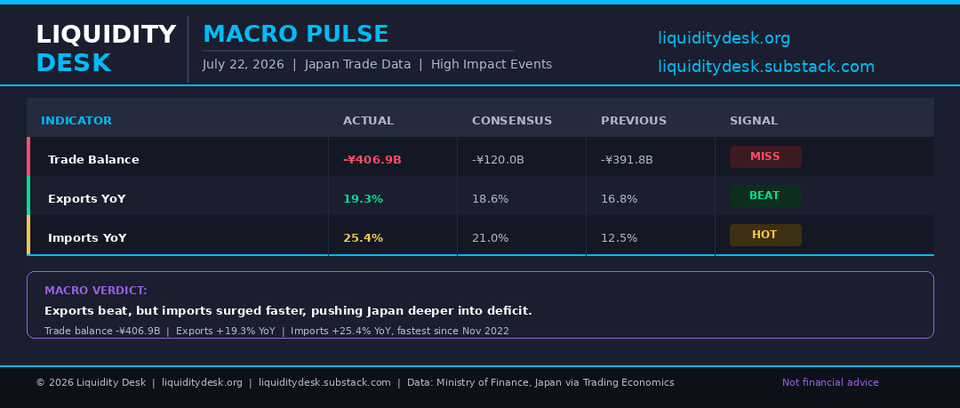
Japan's Exports Are Surging. Imports Are Surging Faster.
Japan's June trade data delivered a strong headline on both sides of the ledger. Exports rose 19.3% year over year, beating the 18.6% consensus and accelerating from 16.8% in May. Imports climbed even faster, up 25.4% against expectations for 21.0%, nearly doubling May's 12.5% pace.
The result was not a stronger trade position. Japan recorded a ¥406.9 billion deficit, much wider than the ¥120.0 billion shortfall expected and slightly worse than May's ¥391.8 billion deficit. This was the second consecutive monthly trade gap.
The data
Export growth reached its strongest pace since November 2022. Shipments were supported by the weaker yen, resilient demand for AI-related semiconductors, and continued strength in autos and capital goods. Exports to China rose 17.6%, shipments to the United States increased 13.0%, ASEAN demand grew 20.0%, and exports to the European Union advanced 20.3%.
The composition matters. Transport equipment exports rose 14.4%, electrical machinery increased 29.4%, and machinery gained 10.9%. Semiconductor-related demand remains one of the clearest external supports for Japanese manufacturing.
Imports tell a more complicated story. The 25.4% annual increase was the strongest since November 2022 and took the total import bill to a record ¥11.34 trillion. Electrical machinery imports rose 32.1%, machinery increased 19.7%, manufactured goods climbed 34.3%, and chemical imports advanced 25.4%.
Crude oil imports surged 59.3%. The source data links part of that increase to energy procurement diversification amid disruption around the Strait of Hormuz. That means the import spike is not simply a clean signal of stronger household demand. It also reflects higher energy exposure, inventory building, semiconductor demand, and supply-security behavior.
The detail the market may misread
At first glance, a 25.4% rise in imports can be interpreted as evidence that domestic demand is strengthening. There is some support for that view, but the composition argues for caution. A large share of the increase came from energy, machinery, intermediate goods, and technology inputs rather than consumer-led demand alone.
That distinction matters because Japan's broader domestic picture remains uneven. The June macro report showed household spending falling 0.5%, the fifth consecutive monthly decline, even as nominal wages rose 3.5% and retail sales increased 5.3%. Business investment also contracted 0.7% quarter over quarter in Q1. The domestic economy is not weak across the board, but it is not yet producing a clean, broad-based demand cycle either.
Why this matters for growth
Japan's first-quarter growth was supported heavily by net trade. A second straight monthly deficit therefore deserves attention, especially when import growth is running six percentage points faster than export growth.
The monthly trade balance does not translate one-for-one into the national accounts. Price effects, services trade, inventory changes, and real versus nominal volumes all matter. Even so, the direction is clear: the external sector is becoming less supportive at the margin unless export volumes continue to accelerate or the energy import bill normalizes.
There is also a margin issue. Japan's producer prices were already rising 6.3% year over year in the June macro report, while consumer inflation remained much lower at 1.5%. A sharp increase in imported energy and intermediate goods can widen that gap further. Companies then face a familiar choice: pass higher costs to consumers, absorb them through margins, or reduce production and investment.
What does this mean for the BoJ?
The trade data adds to the Bank of Japan's policy tension rather than resolving it.
On one side, strong exports, accelerating imports, and elevated producer costs argue against a rapid return to easier policy. The weaker yen continues to support exporters, but it also raises the cost of imported energy and industrial inputs. That is an inflation channel the BoJ cannot ignore.
On the other side, the wider trade deficit, weak household spending, and softer capital expenditure argue against treating the data as evidence of a self-sustaining domestic expansion. Japan is importing more, but not all of that increase represents healthy final demand.
The result is a difficult policy mix: external demand remains strong, imported cost pressure is rising, and domestic demand is still uneven. That keeps the BoJ biased toward normalization, but with less room to move aggressively than the headline trade growth rates imply.
What to watch next
The first question is whether import growth remains above export growth in July. A second question is whether the crude oil surge reverses or becomes persistent. If energy imports stay elevated, the trade deficit could remain under pressure even with strong semiconductor and auto exports.
Also watch real export volumes, not just nominal values. A weaker yen can inflate export receipts in yen terms without producing the same improvement in real activity. For the growth outlook, volume and margin data will matter more than the headline percentage alone.
The bottom line is straightforward. Japan's export engine is accelerating, but the import bill is accelerating faster. That is good news for activity in selected sectors, but not yet good news for the trade balance, corporate margins, or the durability of the broader recovery.