SpaceX IPO: The Biggest Legal Robbery in the History of Financial Markets
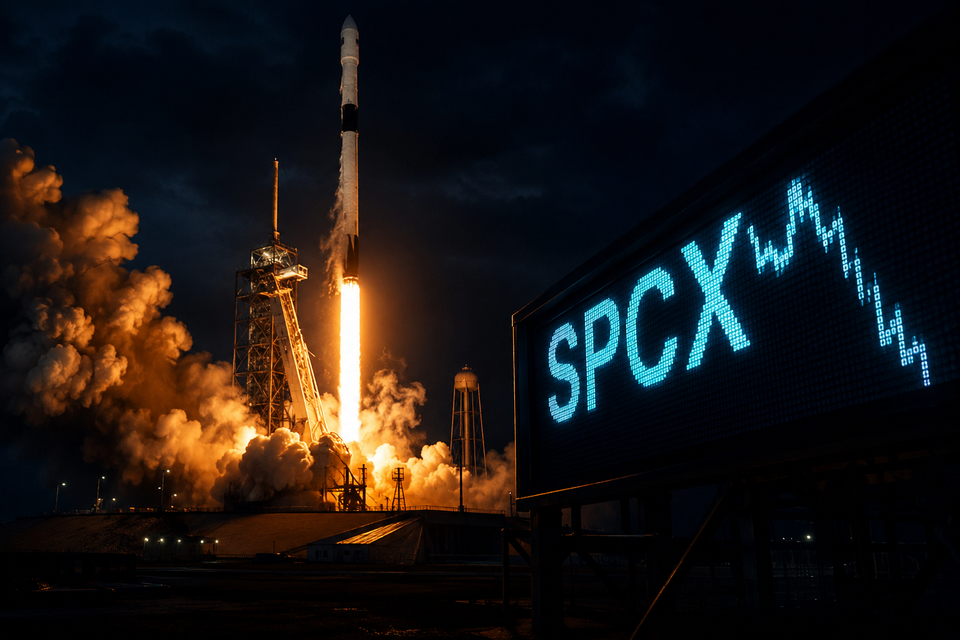
I usually keep a measured tone when writing about markets. I try to explain the mechanics, provide context, avoid drama. But what is being constructed around the SpaceX IPO on June 12 is so brazenly engineered against the ordinary investor that I cannot call it anything else: daylight robbery. Legal, well-packaged, with beautiful presentations and clever lawyers, but robbery.
Let me explain why.
First, Some Context on the Scale
On May 20, 2026, after market close, SpaceX filed its official S-1 prospectus with the SEC. The company plans to raise approximately $75 billion at a valuation of $1.75 trillion. For comparison, Saudi Aramco set the record in 2019 by raising $29 billion. SpaceX wants to raise two and a half times more than that. The debut is scheduled for June 12 on the Nasdaq under the ticker SPCX.
Just to understand what we are talking about: at a $1.75 trillion valuation, SpaceX is being priced at roughly 109 to 116 times its annual revenue. Revenue for 2025 was $18.67 billion. The net loss for the same year was $4.94 billion. That is not a typo. The company loses nearly $5 billion a year and is valued at almost $2 trillion.
Starlink generates operating profit and is the real engine of the business. Everything else burns cash at a breathtaking pace. But let us set the valuation aside for now, because that is a separate conversation. The real problem is how the IPO itself has been constructed.
The Rule They Rewrote for the Occasion
Here is something most people do not know: when a company goes public, it does not automatically enter the major indices. Traditionally it had to wait at least three months, and for the Nasdaq-100 the actual inclusion happened at the annual index reconstitution in December. That waiting period exists for a reason. It gives the market time to establish a real price for the stock, without forcing trillions of dollars of passive capital to buy in from day one.
In March 2026, Nasdaq changed the rules. Officially, the change took effect on May 1, 2026. The new "Fast Entry" rule allows mega-cap companies ranking in the top 40 by market capitalization to be included in the Nasdaq-100 just 15 trading days after their market debut.
Fifteen days. Instead of three to twelve months.
And here comes the important technical detail. SpaceX will offer only a small fraction of its shares to the public. The actual free float, meaning the shares genuinely available for purchase on the open market, will be incomparably small relative to the company's total valuation. Nasdaq solves the problem elegantly: the weight of SPCX in the index will be calculated at a multiplier of up to three times the actual float.
Think about what that means in practice.
The Exit Mechanics, Explained Simply
When an ETF like QQQ tracks the Nasdaq-100, it is contractually obligated to buy the index constituents in proportion to their weighting. No choice, no judgment, no "this stock looks expensive to me." It buys automatically. That is the nature of passive investing.
QQQ manages over $300 billion in assets. Add to that the hundreds of other ETFs and index funds, pension funds and institutions around the world whose mandates require them to track the Nasdaq-100. Total assets benchmarked to the major indices exceed $30 trillion.
When SPCX enters the index after 15 days, all of these funds must buy. Not want to, not decide to. Must.
And they are buying into a situation where the actual shares available on the market are scarce, because Musk and early investors are holding the vast majority. Limited supply, enormous forced demand. The price can only go up. The early investors are waiting in ambush.
This is exit liquidity in its purest form. The people in your pension funds, in your QQQ, in your index portfolio, are financing the exit of the venture funds and insiders who bought into SpaceX ten to fifteen years ago at incomparably lower prices.
And it is all perfectly legal.
The Rocket Fuel: The Lock-Up Period Closes the Trap
There is one counterargument I anticipate: insiders cannot sell immediately. The standard lock-up period is 180 days, meaning early investors and SpaceX employees are locked out until around December 2026.
Except this does not weaken the argument. It actually strengthens it.
Think about it this way: passive funds begin their forced buying 15 days after the debut. They build their positions during a period when insiders still cannot sell and are adding no supply to the market. Small float, plus massive forced demand, plus zero insider supply for six months. That is not a recipe for a stable price. That is a recipe for a vertical chart.
And when the lock-up expires in December, insiders are not selling into a panicked market. They are selling into a market with high liquidity, a supported price, and ready buyers called index funds, which are obligated to absorb the supply in order to maintain their index weighting.
I do not know whether SpaceX will reach Mars. But the price of SPCX will most likely get there first.
Michael Burry Is Even More Direct Than I Am
I am not alone in these observations. Michael Burry, known from "The Big Short," publicly flagged and criticized precisely this mechanic around the Fast Entry rule. When Burry signals something about structural market risks, it is worth paying attention. He has seen these movies before.
Control Stays With One Person
The prospectus reveals a dual-class share structure. Public investors receive Class A shares with one vote each. Musk's shares are Class B with ten votes each. He retains 85.1% of the voting power despite the IPO.
In other words: you provide the capital, he makes the decisions. Forever. No matter how many shares you buy.
It is not illegal. Tesla operates on a similar basis. But you need to know this before you make your decision.
What You Are Actually Buying
When you hear "SpaceX IPO," you picture rockets, Starlink, Mars. That is the marketing. The reality inside the S-1 prospectus is somewhat different.
SPCX is actually four companies in one package.
Starlink
The only thing that works. Over 10 million subscribers, operating profit of $1.2 billion in the most recent quarter alone. This is the real business, the real money, the real justification for the valuation.
Falcon and Starship
Burn cash. Capital expenditures exceed $20 billion per year. Starship is a technological spectacle, but financially it is a black hole that Starlink subsidizes.
xAI and Grok
Burned $6.4 billion in 2025 on revenues of just $3.2 billion. The loss is not narrowing, it is widening. In the first quarter of 2026 alone, AI capital expenditures reached $7.7 billion. One quarter.
X, Formerly Known as Twitter
Perhaps the most uncomfortable detail in the entire prospectus. Musk bought Twitter for $44 billion in 2022, rebranded it, merged it into xAI, and now it is quietly packaged inside SPCX. Advertising revenues fell by $595 million in 2024, partially recovered with a gain of $115 million in 2025, and then fell again by $100 million in Q1 2026 alone. Meta, Pinterest and Reddit reported advertising revenue growth over the same period. X is moving in the opposite direction.
This is what the real portfolio looks like: one profitable business, two expensive bets on the future, and one social network in chronic advertising decline. All of this against an accumulated deficit of $41.3 billion as of the end of March 2026.
Buy SPCX and you buy all four. There is no option to choose only Starlink.
Musk bought Twitter for $44 billion and destroyed it. Now he is selling it to you, packaged between rockets and artificial intelligence, at a valuation of almost $2 trillion. You are not just paying for his mistake. You are paying him a profit on it.This is not audacity. This is shameless arrogance.
Finally
I am not telling you not to buy SPCX. That is your decision and I am not your financial advisor.
What I am saying is this: the rules of the game were changed mid-match, specifically to ensure maximum liquidity for early investors. The pension funds and ETFs where you keep your savings will be obligated to buy automatically. And you are the one paying for it.
Know what you are buying. Or more precisely, know who is selling and why right now.
Liquidity Desk | liquiditydesk.substack.com