Alan Greenspan (1926-2026): The Man Who Taught the World to Expect a Rescue
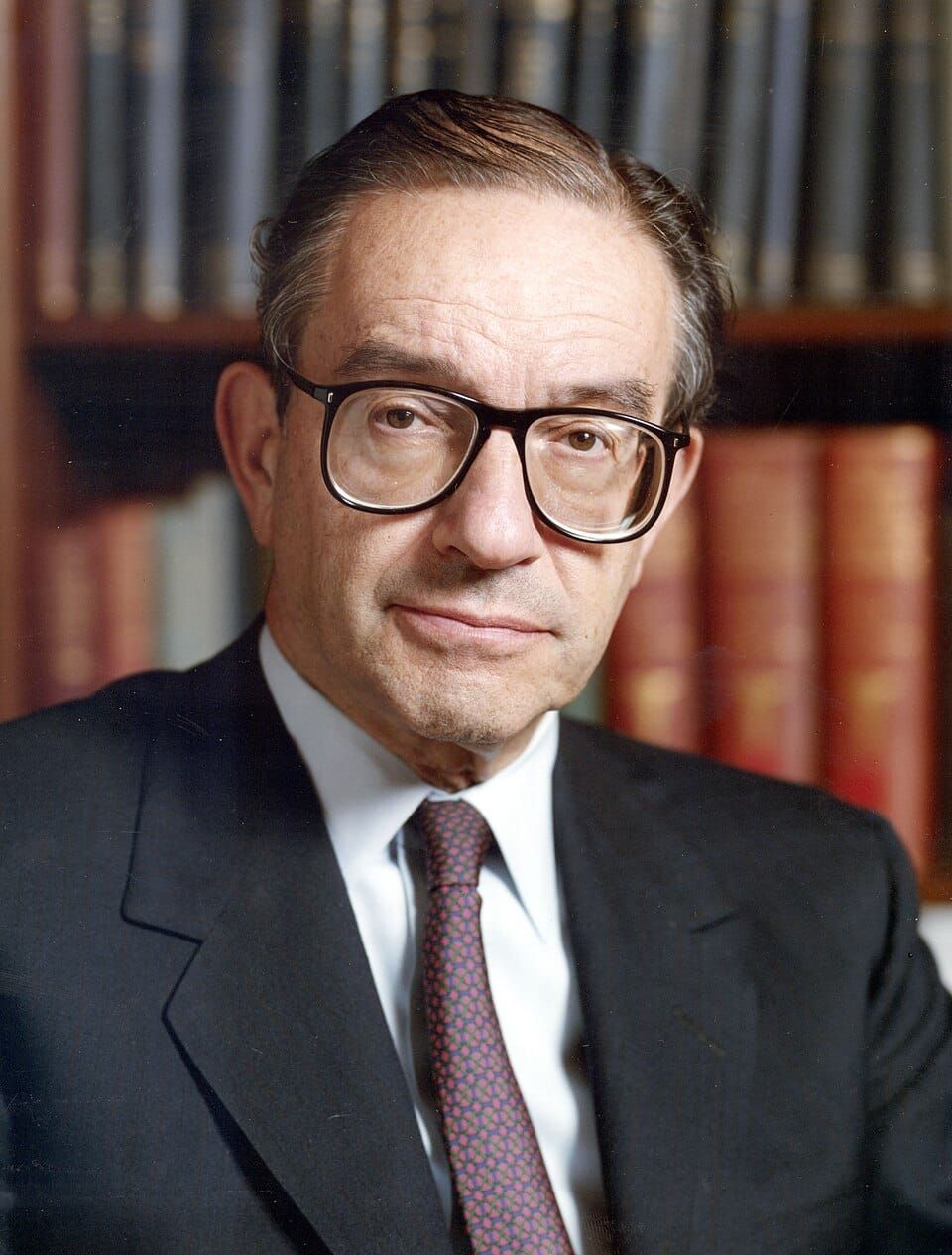
On October 19, 1987, just two months after taking office as Chairman of the Federal Reserve, Alan Greenspan faced his first real test. The Dow Jones Industrial Average fell 22.6% in a single day, a one-day collapse larger than any single session during the Great Depression. The panic was real. Greenspan's response was simple and swift: the Fed would provide liquidity. The markets stabilized. The crisis was contained.
He did not know then that this decision (correct in itself) would become a template that would shape the next four decades of global finance.
Greenspan was a phenomenon in his own right. An economist who grew up in New York, played jazz saxophone in his youth, and became a close intellectual companion of Ayn Rand and her philosophy of laissez-faire capitalism. His belief was deep and sincere: markets are wiser than any regulator, self-regulation works, intervention creates more problems than it solves.
And yet, despite this (or perhaps because of it), he became one of the most interventionist Fed chairmen in history.
His nickname was "the Maestro." He spoke in a language all his own, known as "Fedspeak": sentences so carefully constructed that they said everything and nothing simultaneously. Members of Congress would leave his hearings with the sense that they had understood something important, without being able to explain exactly what. It was an art. And it was power.
In November 2002, at the ninetieth birthday celebration of Milton Friedman, Greenspan delivered words that have since become part of financial history. Standing before one of the most influential economists of the twentieth century, he spoke on behalf of the Federal Reserve:
"You're right, we did it. We're very sorry. But thanks to you, we won't do it again."
Alan Greenspan, Federal Reserve, to Milton Friedman, November 2002 Friedman and Anna Schwartz had proven decades earlier that the Fed had killed the American economy after 1929 not through action, but through inaction: through an excessively restrictive monetary policy at the moment the economy needed liquidity most. Greenspan acknowledged this mistake publicly.
The acknowledgment was correct. The diagnosis was accurate.
But the conclusion Greenspan drew from it was absolute: if a shortage of liquidity kills the economy, then liquidity is the cure for every illness. Every correction. Every crisis. Every disruption.
Friedman had warned him against one extreme. Greenspan embraced the opposite and institutionalized it.
Wall Street understood the rule quickly. It acquired its own name: the "Greenspan Put."
In options markets, a "put" is a contract that protects you from loss, insurance against a crash. The Greenspan Put meant something simpler and more powerful: if markets fell far enough, the Fed would cut rates. Always. Without exception.
1987 Market crash. The Fed provides liquidity. 1994 Bond market crisis. The Fed responds. 1998 The collapse of hedge fund LTCM threatens to bring down the global financial system. The Fed cuts rates three times in two months. 2000–01 The dot-com bubble bursts. The Fed cuts rates from 6.5% to 1.75% in one year. 2001 September 11. The Fed cuts to 1%. 2003 Rates reach 1% and stay there for a full year. Each time the pattern was the same. Each time the rescue came. And each time, market participants internalized the lesson a little more deeply: risk has a floor. Loss has a ceiling. Someone will take care of it.
This is moral hazard in its purest form. When you know you will be rescued, you take more risk. When you take more risk and are rescued again, you take even more. The real estate bubble that inflated after 2003 at 1% interest rates was a direct child of this logic.
Greenspan saw the bubble forming. In his Congressional testimony after 2008 he admitted he had found a "flaw" in his ideology: his belief that banks would protect the interests of their shareholders had proven wrong. The words were honest. But they came too late.
Greenspan left the Fed on January 31, 2006. His successor, Ben Bernanke, was an academic who had specialized in the Great Depression, deeply convinced by the lesson of 1929. When the 2008 crisis struck, Bernanke did not hesitate. He deployed quantitative easing on a scale unimaginable even to Greenspan. The Fed's balance sheet grew from $900 billion to $4.5 trillion.
Janet Yellen inherited and maintained it. Jerome Powell inherited it, and during the 2020 pandemic brought the balance sheet to $9 trillion. Interest rates fell to zero for the second time in history.
None of them invented this logic. All of them were executing an inheritance.
Greenspan's philosophy did not die with his tenure. It passed on like DNA: every round of QE is a child of the Greenspan Put, every zero interest rate policy is a grandchild of the decision made in October 1987.
Alan Greenspan died today, June 22, 2026, at the age of 100.
He dies at the precise moment when, perhaps for the first time in decades, the Federal Reserve is showing signs that this philosophy is ending. On June 17, 2026, just five days before his death, new Fed Chairman Kevin Warsh announced that forward guidance, the instrument with which the Fed had managed market expectations for decades, is no longer appropriate for this moment. The dot plot median shifted to 3.8% for end of 2026. Half of the Committee expects at least one rate hike this year. The policy statement was cut to under 150 words. There was no signal of easing.
Greenspan built a world in which markets expected a rescue. Warsh is telling markets to stop expecting one.
The door to his era has closed.
Member discussion