Macro Pulse | June 23, 2026 | Japan Macro Data Release
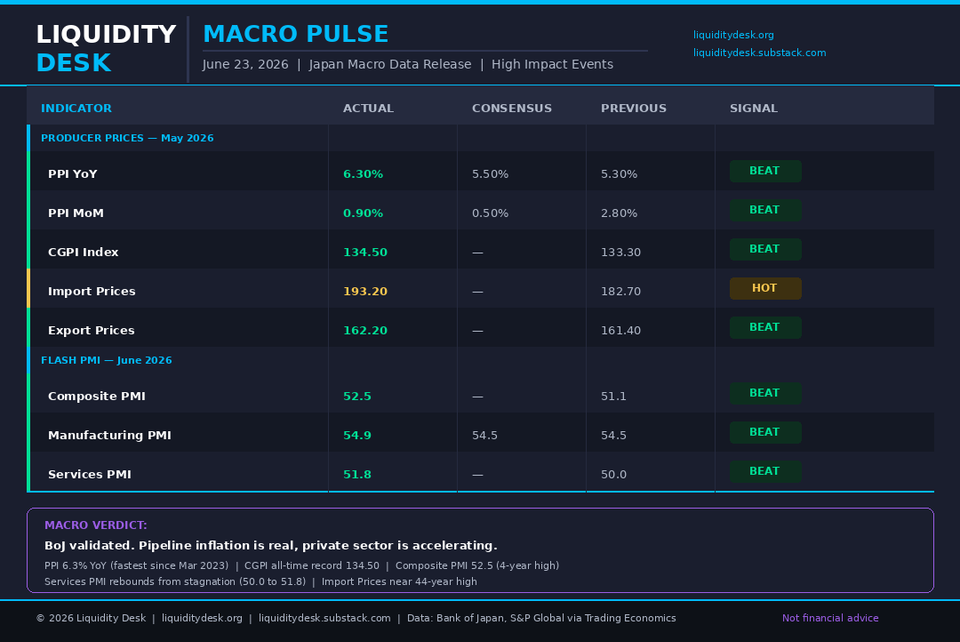
The Bank of Japan raised rates to 1.00% on June 16. It called the move a structural inflation call, not a crisis reaction. The data released since then is beginning to confirm that judgment.
Japan's producer price index rose 6.3% year-on-year in May, above the 5.5% consensus and up from 5.3% in April. That is the fastest annual pace since March 2023. The Domestic Corporate Goods Price Index, which measures prices of goods traded within the corporate sector, reached an all-time record high of 134.50 points. Import prices climbed to 193.20, close to levels not seen since October 1982. These are not temporary distortions. They are pipeline signals, and the pipeline is full.
The inflation structure
The breakdown of Japan's PPI tells a specific story. Petroleum and coal prices rose 13.8% year-on-year, up sharply from 5.3% in April. Chemicals gained 13.4%. Information and communications equipment added 13.1%. These three categories together account for a substantial portion of Japan's intermediate goods cost structure. When energy and chemicals move together at double-digit rates, the pressure does not stay upstream. It moves through the production chain toward final prices over the following one to three quarters.
The prior editions of this series raised a recurring question. Consumer inflation in Japan remained below the BoJ's 2% target through May, with core CPI ex food and energy at 1.80%, the softest reading since September 2022. The CPI data pointed in one direction. The PPI data pointed in another. The divergence was framed as margin compression. Japanese manufacturers were absorbing cost increases rather than passing them to consumers, because domestic demand was too weak to support price hikes.
That framing was accurate for the period it described. What May PPI adds is duration. This compression is now running at 6.3% on the producer side against sub-2% on the consumer side. That spread cannot widen indefinitely. Either consumer prices eventually follow, or corporate margins collapse. The BoJ's structural call is premised on the former.
The standout signal
Import prices at 193.20 points deserve specific attention. The all-time high for this series is 198.10, reached in October 1982, at the tail end of the oil shock era. Japan is now within 2.5% of that historic peak. Japan imports virtually all of its energy and a significant share of its industrial raw materials. When import prices approach 44-year highs, the cost base for the entire economy shifts. The yen's weakness amplifies every commodity price move denominated in dollars. This is not a transient effect of the Middle East conflict. It is a structural feature of Japan's import dependency that the BoJ explicitly cited in its June 16 statement.
The economy is not slowing under the hike
The concern after any rate increase is that the real economy contracts before inflation is contained. The June flash PMI data provides the first post-hike read on private sector activity. The Composite PMI rose to 52.5, the highest level since July 2022. Manufacturing came in at 54.9, the strongest expansion since January 2022, marking six consecutive months of growth. Services rebounded from 50.0 in May, where activity had stalled for the first time in over a year, to 51.8 in June.
These are not marginal improvements. Manufacturing at 54.9 is well into expansion territory. Services returning to growth after a single month of stagnation removes one of the key dovish arguments that surrounded the June 16 decision. The critics of the hike pointed to services stagnation as evidence that domestic demand could not sustain monetary tightening. That argument now requires revision.
Employment in manufacturing grew at the fastest pace in more than eight years. New orders rose at the quickest rate in four months. Backlogs of work increased for the fifth consecutive month. On every operational dimension, the manufacturing sector is running hotter after the hike than before it.
What does this mean?
The narrative that has run through this series since May has been a question. The BoJ made a structural inflation call. Was it right? The May PPI and June flash PMI, taken together, provide the clearest answer yet. Yes.
Producer prices are accelerating at the fastest pace in over three years. The corporate goods price index has never been higher. Import costs are near historical peaks. At the same time, the private sector is expanding at rates not seen since 2022, with both manufacturing and services contributing. The economy is not buckling under 1.00% rates. It is growing through them.
This matters for how the next phase of BoJ communication is interpreted. The bank has been explicit that it is data-dependent and meeting-by-meeting. The data now arriving post-hike is not providing reasons to pause. It is providing confirmation that the conditions the BoJ cited when it hiked are present in the numbers.
The next question is not whether the June 16 decision was correct. The next question is what the July meeting looks like. That is a different post for a different data set.
What to watch next
June Tokyo CPI, due in late June, will be the first inflation gauge to capture price dynamics in the weeks immediately following the hike. It carries disproportionate weight because Tokyo data leads the national release by roughly three weeks. If Tokyo core CPI continues to recover toward 2%, the structural case strengthens further. If it softens again, the question reopens.
The July BoJ meeting is the next policy event. Between now and then, the full national CPI for May releases on June 27, followed by industrial production, retail sales, and labor market data for May. The picture forming from PPI and PMI suggests those releases will not give the BoJ reason to reverse course.
Not financial advice. Data: Bank of Japan, S&P Global via Trading Economics.
Member discussion