

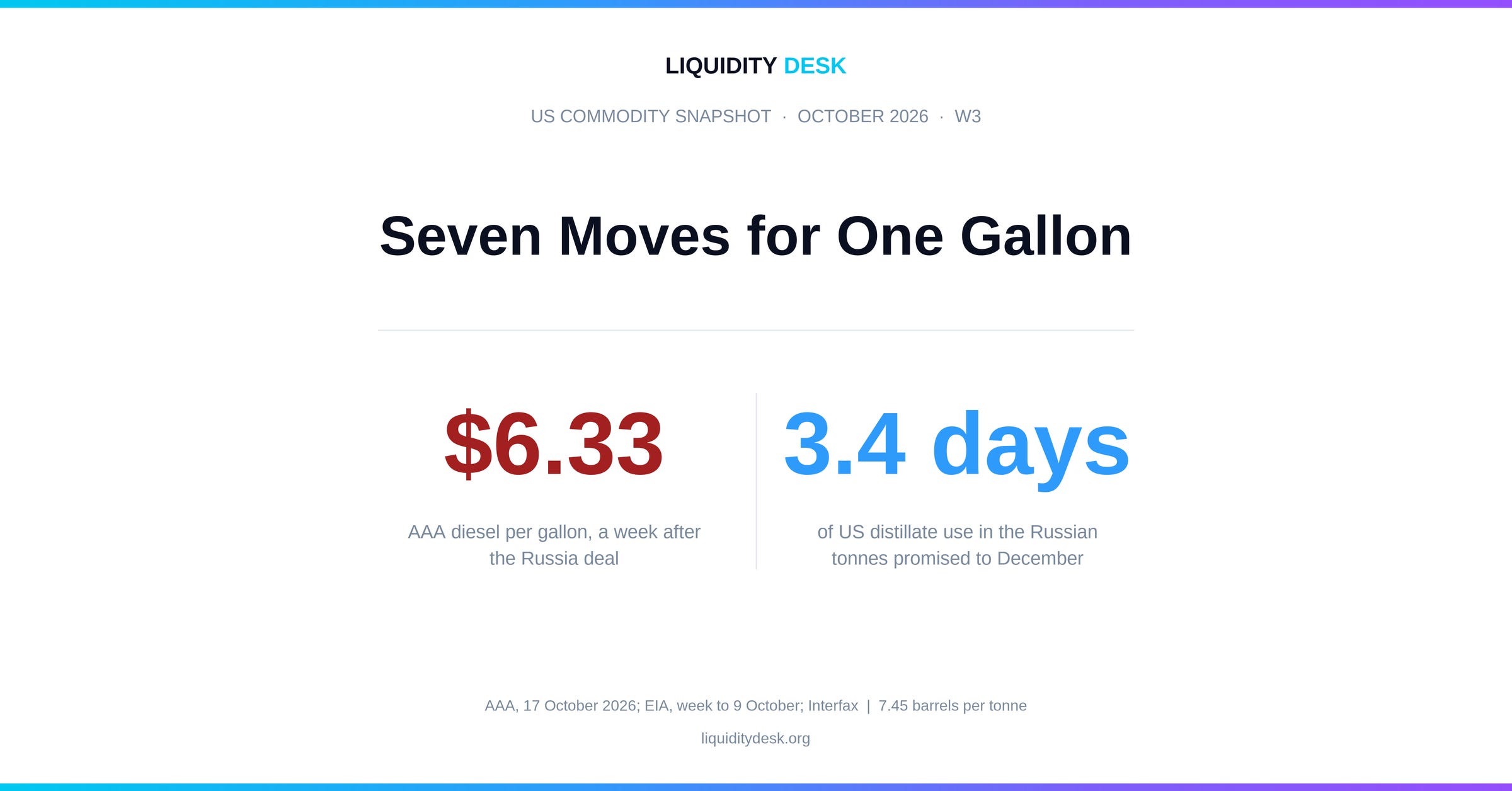
In four weeks the White House made seven moves against the price of diesel. It signed a law imposing the toughest sanctions yet on Russian energy, considered a ban on US diesel exports, agreed a release of G7 emergency reserves, allowed dyed off-road diesel on the highways, struck a deal with Putin for Russian diesel, announced an “energy ceasefire”, and finally suspended its own law two days before it was due to take effect. Each move answered the one before, like a game of chess in which the opponent is not Russia but the price of diesel. Policy changes with a signature. Diesel arrives by tanker. One week after the deal with Moscow, the average pump price of diesel tracked by AAA is $6.3276 a gallon, 0.72% higher than a week earlier and 73.72% higher than a year ago. Distillate inventories are 12.2% below their seasonal norm, and 29% below it on the East Coast. The Russian volumes announced through December equal about three days of US distillate consumption. The midterm elections are two weeks away. The deal can work through the global market, but not in time for the data published before the vote.
Sanctions can be lifted in a day. Inventories take months to refill.
Energy: seven moves in four weeks
The September edition ended on the conclusion that neither the Fed nor the White House could produce a spare gallon of diesel within a week. Over the following month Washington tried to do exactly that. Not with refineries, but with decisions.
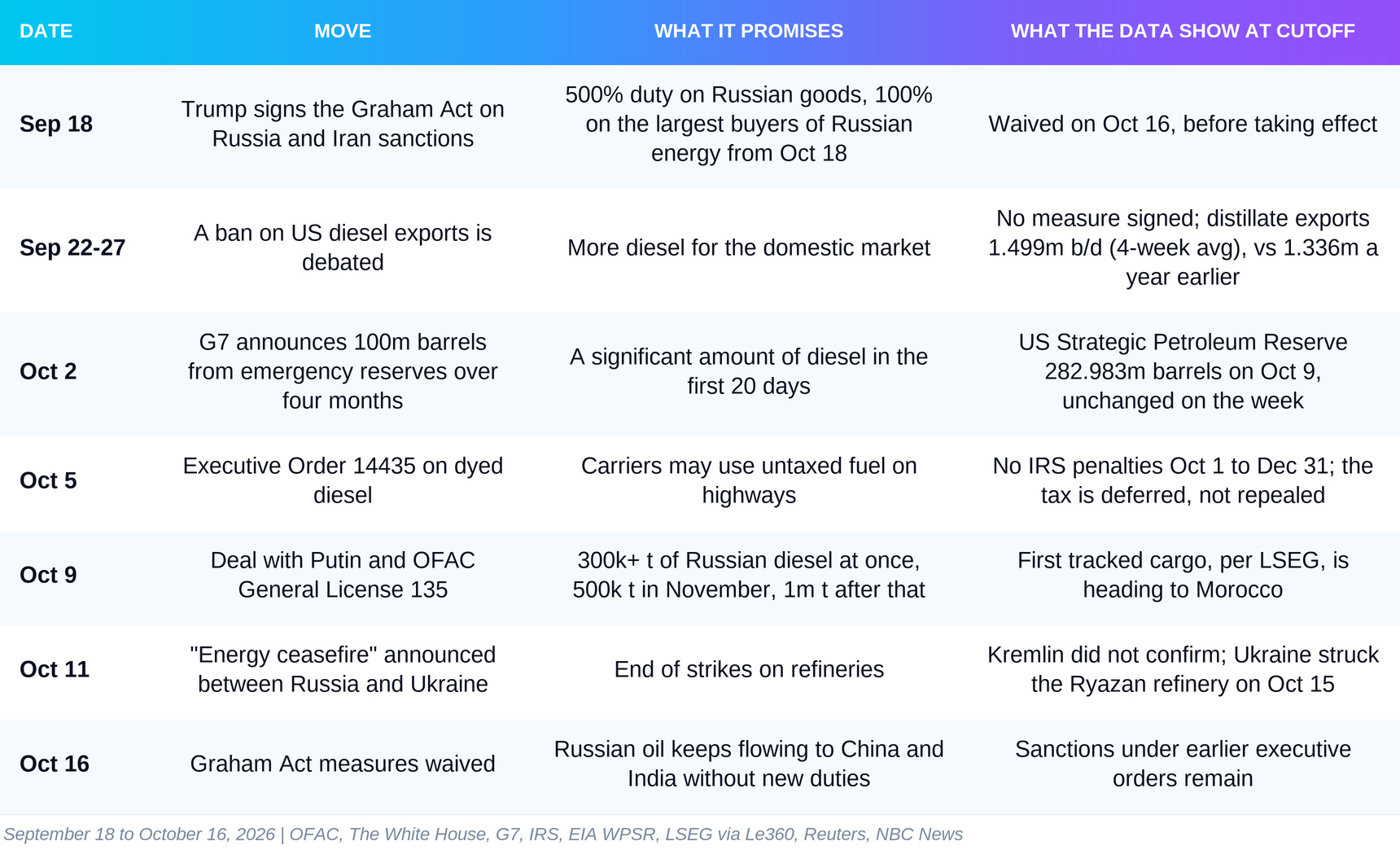
The three October moves deserve the closest reading, because they pull in opposite directions on the same law. On September 18 the President signed the Lindsey O. Graham Sanctioning Russia and Iran Act of 2026. The Senate had passed it 86 to 11. It provided for a 500% duty on Russian goods and a 100% duty on goods from the five largest importers of Russian oil and gas if they made new purchases from October 18. On October 9 OFAC, the Treasury office that administers sanctions, issued General License 135. A general license is an exemption from sanctions that applies automatically to everyone, with no need to apply for a separate permit. Until April 7, 2027, it authorises the sale, delivery, offloading and importation of Russian diesel, including into the United States. The sanctions on Russia remain in place, and the license can be withdrawn at any time. On October 16, two days before the deadline, the President used his authority under section 115 of the law to waive all of the new duties and most of the new sanctions as being “in the national interests of the United States”.
The White House logic is about energy, not foreign policy. Had the 100% duty taken effect, China and India would have had to choose between Russian oil and the US market. Every barrel left unsold because of that choice drops out of the global balance at a time when Hormuz is still not operating normally. A sanction on the buyer of oil works like a cut in supply, only slower. The waiver is therefore consistent with the goal of cheaper fuel, even where it contradicts the purpose of the law. Reuters cites analysts who said the new measures could have pushed oil prices higher weeks before the election. China and India, two of the largest buyers of Russian oil, had protested against the law.
The market believed it at first. On October 8 ULSD in New York Harbor, the physical spot price of ultra-low sulfur diesel, was $5.305 a gallon. On October 9, the day of the deal, it fell to $4.910, a 7.45% drop in a single session. By October 14 it had recovered 39% of the fall and stood at $5.066. The Kremlin did not confirm the “energy ceasefire”, and it did not last a week. According to Zelenskiy, Russia kept striking Ukraine’s power system, and on October 15 Ukraine hit Rosneft’s refinery in the Ryazan region. On October 16 November WTI settled at $101.41 a barrel, up 3.51% on the day, and the NYMEX HO futures contract at $4.8991 a gallon. That session closed before the Graham Act waiver was signed late in the evening.
The pump moves more slowly than the exchange, but here the direction matters. According to the EIA, the average highway diesel price was $6.179 a gallon in the week of October 12. That is 5.36% below the nominal record of $6.529 set in the week of September 21. AAA’s daily data, however, show a new rise after the deal: $6.2824 on October 10 and $6.3276 on October 17. Gasoline is holding up better. Regular gasoline tracked by AAA is $4.3085, 2.93% below its level a month ago, but still above the $4 political threshold.
The physical buffer explains why the relief is only partial. As of October 9, US distillate inventories stood at 102.6 million barrels. By our calculation that is 12.2% below the average for the same week in 2021-2025. The East Coast deficit is 29%, and New England holds 40.7% less than a year earlier just before the heating season. Refineries are running at 93.5% of capacity, down from 96.8% in mid-September but far above the 85.7% of a year ago. High throughput is not enough, because exports remain strong. Over the last four weeks the US exported an average of 1.499 million barrels of distillates a day, against 1.336 million a year earlier.
Crude oil tells a different story. Brent for physical delivery was $126.55 on October 14 according to the EIA, while WTI at Cushing was $101.91. The $24.64 gap is twice the $12-13 threshold we set in our analysis of the diesel export ban. The seaborne barrel carries the premium of war and freight, while the American barrel stays on land. The American side of that gap is not a shortage of crude. It is a shortage of finished fuel. Natural gas is the counterpoint to the idea of a general energy shortage. Working gas in storage was 3,567 billion cubic feet on October 9, 45 billion above the five-year average. Henry Hub spot is $3.22 per MMBtu. American gas has its own balance, and for now it is sufficient.
The US commodity dashboard
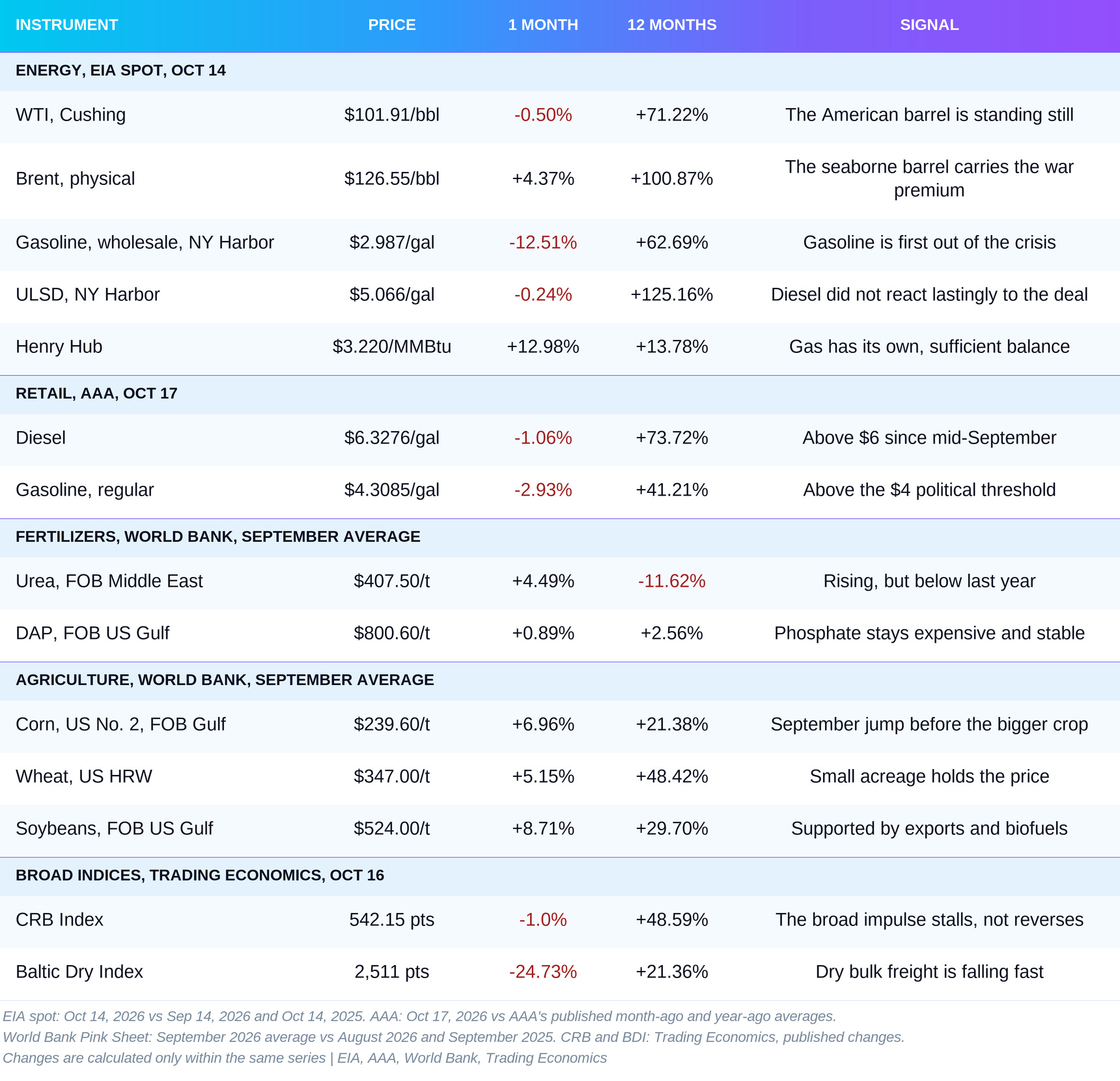
The dashboard shows a market that is splitting apart. US crude is almost unchanged over the month, wholesale gasoline is down 12.51%, and diesel is standing still. Agricultural prices jumped in September, but October futures quotes are already lower. The CRB is down 1.0% for the month and the BDI has lost almost a quarter. The shock is no longer broad. It has narrowed to diesel.
Urea is quoted on the international benchmark, FOB Middle East, not US Gulf. The USDA regional report for Oklahoma puts it at $638.08 a ton at the dealer as of October 16. The two prices belong to different markets and are not compared as a percentage.
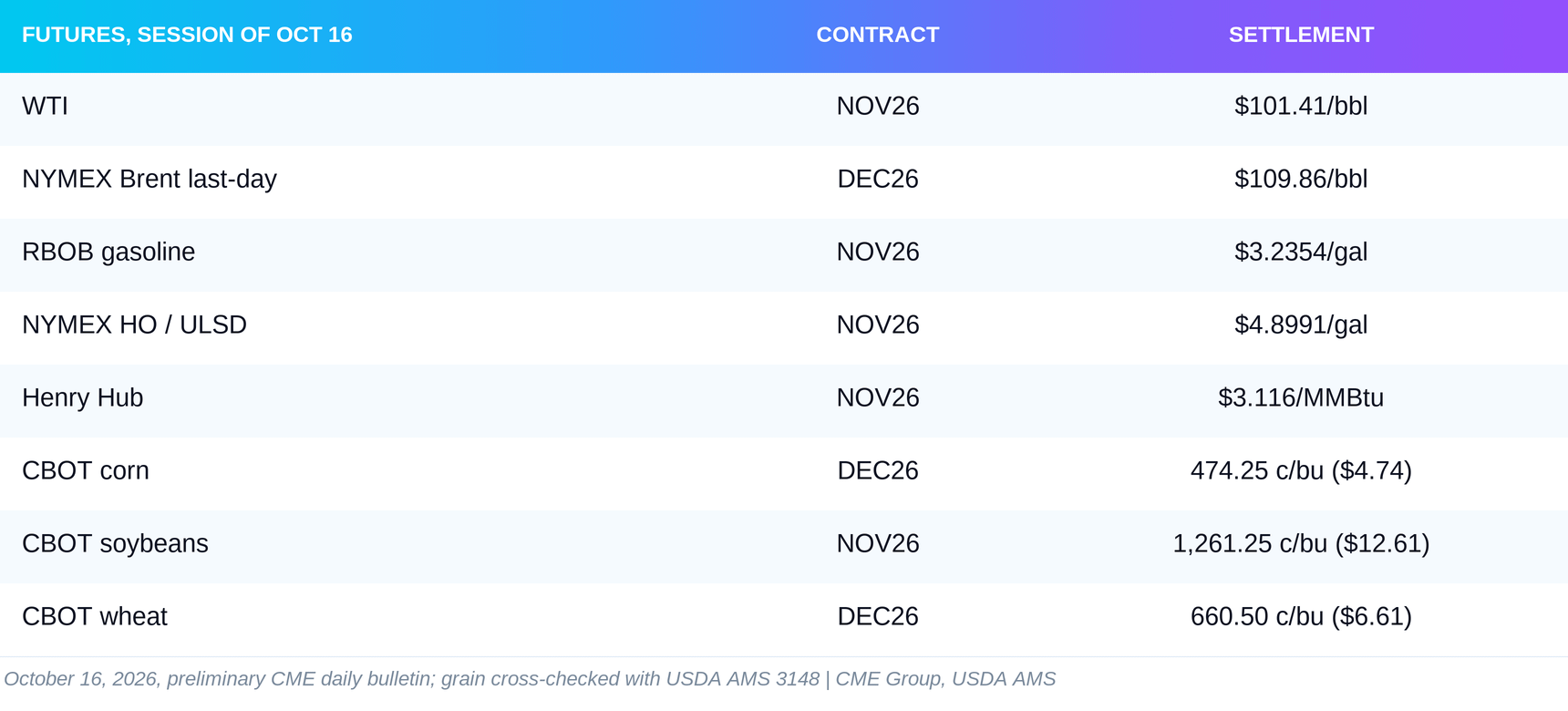
The two Brent prices are not an error. $126.55 is the EIA spot price for a physical cargo. $109.86 is the NYMEX futures contract for December delivery. The difference shows how much more a barrel costs today than a barrel two months out. That is a tight market, but the curve is not a clean forecast of future prices. A Fed analysis of October 9 warns that under the current shock futures also include a risk premium and reflect low liquidity.
The dashboard is built from spot prices and monthly averages. Futures contracts are shown separately, because their official history is not publicly available, so for them we give only the latest settlement, on October 16.
The Russian deal in barrels
The deal is announced in tonnes, while America measures fuel in barrels and gallons. So we convert first. At 7.45 barrels per tonne, the firm volumes of 300,000, 500,000 and 1 million tonnes add up to 1.8 million tonnes, or about 13.4 million barrels. With the conditional tranche of another 3 million tonnes “depending on the condition of Russia’s refineries”, the total becomes 4.8 million tonnes, or about 35.8 million barrels.
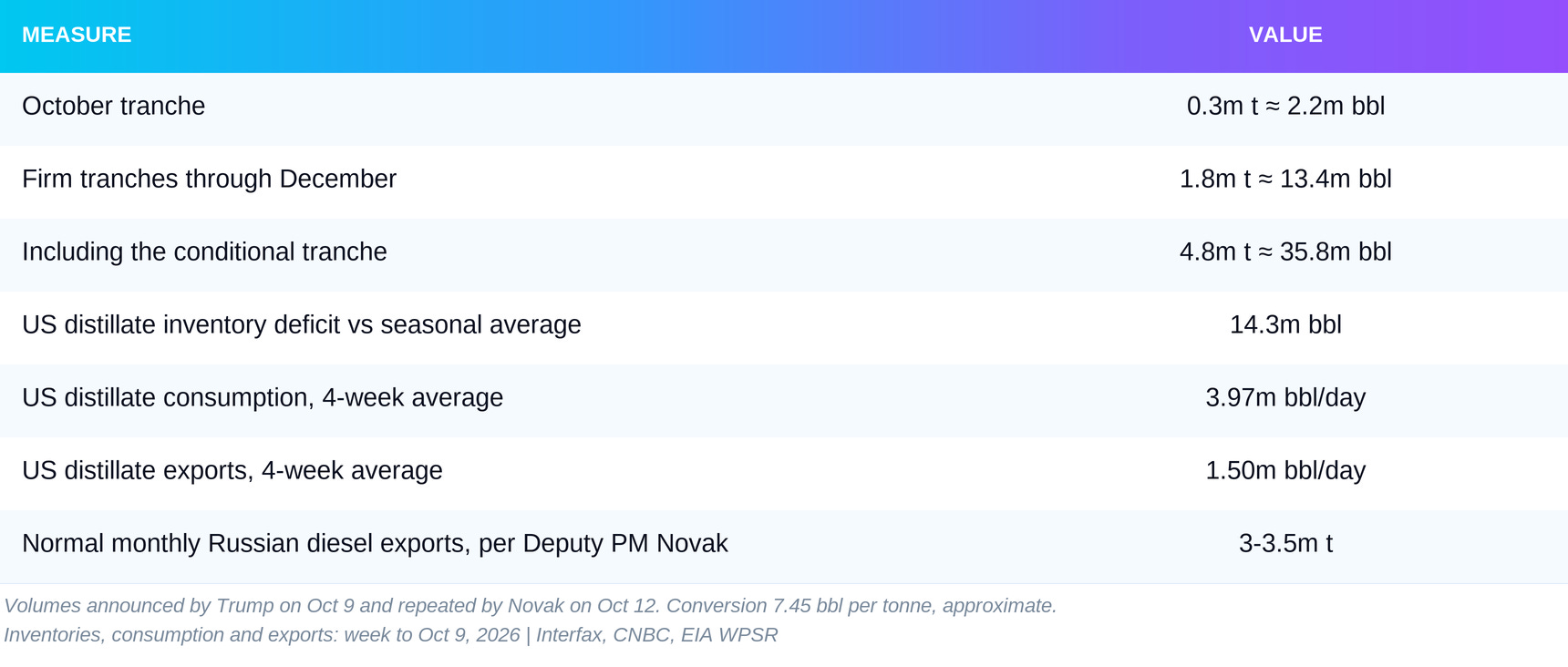
The numbers say two things at once. The firm tranches almost match the US deficit against the seasonal norm, at 94% of it. That sounds substantial. Yet the same 13.4 million barrels equal about three and a half days of US distillate consumption and a little more than one week of US exports. The October tranche covers half a day. And the entire firm volume through December is about half of one normal month of Russian exports before the crisis.
The deal is not for the American market. It is for the world market. Diesel is fungible: every tonne of Russian fuel that reaches Morocco, Turkey or Brazil reduces demand for American diesel there. That is the strongest argument in the White House’s favour. US refiners can export less without anyone banning them, and inventories at home can refill. The channel is real, but it is indirect and slow. It runs through lower prices in foreign markets, then weaker demand for US exports, and only then higher inventories in New York and Boston.
The law is part of the delivery too. The OFAC license authorises transactions under the sanctions regulations, but does not mention the 2022 law ending imports of Russian oil. That law bans imports of Russian petroleum products into the United States, and the President can lift it only with a certification to Congress. Senators from both parties argue that the license violates the law. European and British sanctions remain in force. The EU price cap for Russian diesel is $100 a barrel. European tankers, insurers and banks can take part only if the fuel was bought at or below that price. Diesel in New York costs about $213 a barrel. Russian diesel can become legal in America and still not find a legal ship. Nor does the license cover the blocked tankers of the “shadow fleet”.
Then there is the refinery in Russia. Ukrainian strikes have cut Russian refining, and Russia itself restricted exports to keep its own market supplied. Moscow partially lifted the restrictions from October 10. On October 15 Ukraine hit Rosneft’s refinery in the Ryazan region, about 5% of Russian refining. The more Russian capacity goes offline, the less is left for the promised tonnes.
The deal also has a price that does not show up in fuel. Criticism came from both parties in Congress, and Zelenskiy called the easing of sanctions a “gift” to Putin. The license explicitly does not authorise debits to accounts of the Russian central bank, the National Wealth Fund or the Ministry of Finance. It cannot, however, avoid generating revenue for Russian oil companies. On October 9 Rosneft shares rose 9%. We are not assessing foreign policy here. We note that the license can be revoked at any time. The market will price it with a risk discount until it sees a steady flow.
The transmission chain: from decision to receipt
Channel 1: crude oil to the gasoline pump
Gasoline is the only channel where the relief is clear. The wholesale price in New York Harbor fell 12.51% over the month to $2.987 a gallon. The EIA average for all grades of gasoline was $4.471 in the week of October 12, against $4.61 in the week of September 21. For drivers that is a little relief, but the annual increase remains around 40%. The $4 political threshold has not been broken to the downside.
Channel 2: ULSD to freight and producer prices
Here the September forecast was fully confirmed. We said in the September edition that the September PPI would carry a stronger diesel imprint. The BLS producer price of diesel jumped 21.0% in a single month and is 115.2% above a year earlier. Truck transportation of freight rose 3.8% over the month, and long-distance truckload trucking 4.6%. Energy within final demand goods is up 10.8%. Overall PPI is 1.3% higher on the month and 6.3% on the year. These are preliminary data and subject to revision. Freight is already in business costs. The question is how fast it reaches the shelf, and the September CPI gives an unexpected answer. Food prices were unchanged over the month, at 2.5% annually. Expensive diesel does not automatically raise food prices in the same month. Part of the cost is absorbed by carriers and retailers. Part will arrive later. Part may never arrive if diesel gets cheaper before contracts are renewed.
Channel 3: gas and urea to the next season
Urea rose 4.49% in September on the international benchmark, but remains 11.62% below its level a year ago. The World Bank fertilizer index is almost unchanged. US gas is cheap, and storage is above normal. This is the weakest of the four channels. The risk to fertilizer use next spring depends more on gas in Europe, which is 128.6% more expensive than a year ago, than on Henry Hub. Farm diesel in Oklahoma is $5.46 a gallon, 7 cents cheaper than in the previous report. The relief for farmers is smaller than the relief on the exchange.
Channel 4: biofuels hold up demand
Biofuels do not depend on a fixed WTI price threshold. They depend on EPA mandates and on the price of diesel. The USDA expects 5.650 billion bushels of corn for ethanol and co-products in 2026/27, 50 million more than in the September forecast. Soybean oil for biofuels is projected at 17.8 billion pounds, against 14.8 billion last year. Expensive diesel makes biodiesel more competitive and lifts demand for soybean oil. That is one reason soybeans remain above $12 a bushel with planted area 7% larger than last year.
Corn: the harvest is bigger than the fear
The September edition presented corn as the strongest fundamental case for expensive grain. The forecast of a weaker crop, the costly harvest and a price of $5.28 a bushel reinforced one another. A month later, two of the main premises have weakened. The USDA raised its forecast. The average yield is 181.2 bushels per acre, 2.7 bushels above the September estimate. Production rises to 16.034 billion bushels, 234 million more. Beginning stocks were raised by 173 million bushels after the quarterly stocks report of September 30. As a result, ending stocks for 2026/27 jump 18% to 1.849 billion bushels. The stocks-to-use ratio, the main measure of how much grain remains as a reserve, rises from 9.68% to 11.34%.
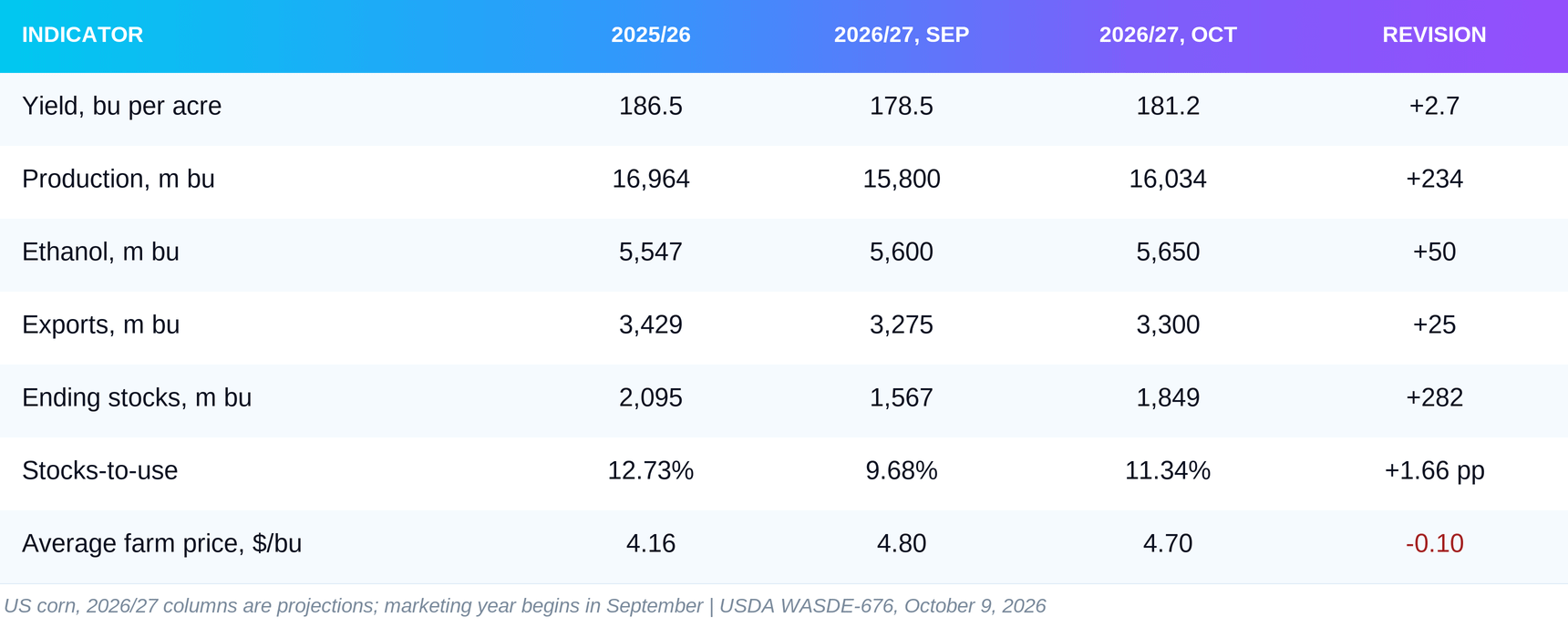
The exchange took it in quickly. The December contract is at 474.25 cents a bushel, about 10% below the 527.50 cents in our September dashboard. The two prices come from different sources, so the comparison is a guide rather than an exact return. The normalisation signal we set in September was corn below $4.75. It has now fired. The opposite signal, corn above $5.25 until harvest passes 25%, failed. Harvest is 33% complete as of October 11, and the price is half a dollar below the threshold. That does not mean America has a surplus. Production is still 5.48% below last year’s record, and ending stocks remain below the 2.095 billion bushels of 2025/26. The difference is that the shortage is no longer deepening. Harvest is running behind average, at 33% against 39%, and 56% of the crop is rated good or excellent. A slow harvest with expensive diesel means a costlier harvest, but not less grain.
The futures curve supports this picture. The March contract is 486.5 cents, 2.58% above December. That premium mainly covers storage and financing of the grain until spring. It looks more like a market with enough grain than a market that pays any price for immediate delivery. Soybeans and wheat do not follow corn. Soybeans are at $12.61, supported by biodiesel and exports, with ending stocks almost unchanged at 315 million bushels. Wheat is at $6.61. It lost its September break above $7, even though the US crop is 22.9% smaller than last year’s. The reason is weak exports: the USDA cut them by another 25 million bushels. A small harvest does not make grain expensive if the world does not want to buy it. The conclusion for food is calmer than in September. Diesel makes harvesting and freight more expensive. The grain itself, however, is getting cheaper, and grain is the larger part of the cost of feed, flour and ethanol.
CRB at 542: the impulse stalls without reversing
The CRB Index stood at 542.15 points on October 16. That is 1.0% below its level a month ago and 48.59% above a year ago. The index remains above the 500-point threshold we have watched since July, but it is no longer making new highs. We need to correct a description from earlier editions. From the close of May 8, 2026, FTSE Russell changed the index composition. It now contains 22 commodities, with weights of 39% energy, 34% agriculture and livestock, 9% precious metals and 18% industrial metals. The old split of 39% energy and 41% agriculture, which we also used in September, no longer applies. The change is methodological, not a market move. It means metals weigh more and grain less than we wrote.
World Bank monthly data show how narrow the September shock was. The energy index rose 25.65% over the month, while the non-energy index rose only 1.32%. Fertilizers were almost unchanged, and precious metals fell 1.91%. Copper is 44.97% above a year ago, but up only 1.03% for the month. This does not look like a general flight into commodities. It looks like one expensive product surrounded by very calm markets. The Baltic Dry Index lost 24.73% over the month. The BDI tracks dry bulk cargoes such as grain, ore and coal, not oil tankers. Its decline says nothing about the cost of shipping diesel. It does say that physical demand for bulk commodities is not following the diesel shock. A full cycle reversal would require the CRB below 400, WTI below $70 and a broad simultaneous decline in every group. None of the three is in place. The more accurate description is a correction within the cycle. Energy keeps the index high, while agriculture and metals have stopped pushing it higher.
The Fed: the Russian diesel decision is a monetary move
The Federal Reserve has held its target range at 3.75-4.00% since the September 16 increase. The next meeting is on October 27-28, six days before the election. The September projections put the median rate at the end of the year at 4.1%, which leaves room for one more small step up. The September CPI does not make the decision easier. Headline inflation is 3.7% annually and 0.6% for the month, up from 3.4% in August. Core inflation, excluding food and energy, accelerated to 2.6% annually from 2.4%. Energy is 20.4% above a year ago, gasoline 34.2% and fuel oil 74.2%. PCE, the Fed’s preferred index, was 3.4% in August and core PCE 3.0%. The September data are not due until November 4, after the Fed meeting and the day after the election. The Fed will therefore decide without seeing September’s energy surge in its preferred index. PPI at 6.3% annually shows that pressure in business costs is stronger than pressure in the consumer basket.
This is where the two institutions meet. The minutes of the September meeting, published on October 7, warn that the longer energy stays expensive, the greater the risk that sector-specific pressure spreads across the whole economy. The Fed cannot produce diesel. The White House is trying to secure it through sanctions policy. When the interest rate cannot increase supply, the government starts conducting monetary policy with other instruments. If Russian tonnes and G7 reserves bring diesel down, the Fed gains room to pause. If they fall short, the Fed will have to respond to 0.6% monthly headline inflation with a tool that hits demand rather than the shortage. The supply shock trap remains the same, but who pays for it is changing. In September it was paid by the carrier and the farmer. In October part of the bill was shifted onto the sanctions regime against Russia. That is a political choice, not a market outcome, and therefore easier to reverse.
What we are watching over the next 30 days
The coming month has a clear calendar. The FOMC meets on October 27-28. The election is on November 3. The October CPI will be published in mid-November. The Russian November tranche of 500,000 tonnes must be loaded over the same weeks. To judge the deal, it is not enough for diesel to get cheaper for one session. We need higher inventories and a lower pump price at the same time.
Signals that the promise is being delivered
EIA diesel falls below $6 a gallon for two consecutive weeks by mid-November. It is now $6.179. This would be the first relief at the pump that carriers feel in their fuel surcharges.
The distillate inventory deficit against the seasonal average narrows below 8% by mid-November, and the East Coast below 20%. It is now 12.2% and 29%. This is the only proof that global tonnes are reaching the American buffer.
NYMEX HO / ULSD falls below $4.25 a gallon and stays there for at least two weeks. It is now $4.8991. Without this, the retail price has no room to come down.
Publicly tracked Russian cargoes consistent with the November tranche of 500,000 tonnes. An announced volume is not a loaded volume.
Signals that the promise stays on paper
OFAC amends or withdraws General License 135, or the license is challenged in Congress or in court. The legal knot with the 2022 law is the easiest point of failure.
New strikes reduce Russian capacity and Moscow tightens export restrictions again. The Ryazan strike shows that the “energy ceasefire” is not working.
AAA diesel returns above the $6.5276 record. It is now $6.3276. That would mean the deal has been swallowed by a new shock.
The October PPI shows another monthly increase in truck transportation of more than 1%. That would confirm that cost pressure continues regardless of the policy measures.
Scenario framework
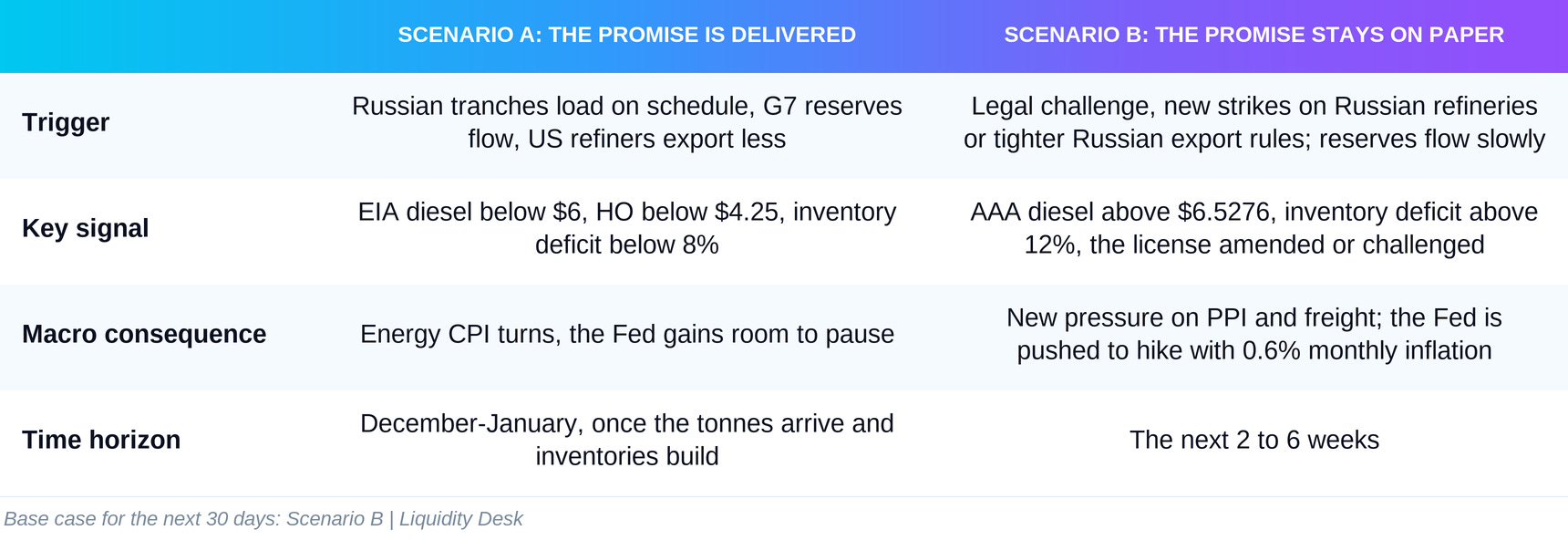
Our base case for the next 30 days is Scenario B: the promise stays on paper. That does not mean the Russian deal is pointless or that it will never work. It means it is too slow for this window, and the November 3 election is two weeks away. Scale is the first reason. The 300,000 tonnes of Russian diesel promised for October come to about 2.2 million barrels. Americans burn that much in distillates in roughly half a day. On public data, only one Russian cargo has been tracked so far: about 40,000 tonnes, loaded on October 13 and heading to Morocco. That is just over one eighth of the amount promised for the month. The reserves are the second reason. On October 2 the G7 promised 100 million barrels from its emergency stocks, but did not say how much each country would provide. The US Strategic Petroleum Reserve holds crude oil, not diesel, and as of October 9, a week after the pledge, it had not released a single barrel. A week is a short time for a sale of this kind, but so far the G7 pledge does not show up in the US data. The pump is the third reason. If the market believed Russian diesel would soon ease the shortage, the retail price would have started to fall. Instead, AAA diesel rose from $6.2824 on October 10 to $6.3276 on October 17.
Scenario A, in which the promise is delivered, is more likely for the winter. The condition is that Russia really does return its diesel exports to 3-3.5 million tonnes a month, its pre-crisis level, and that its refineries are not hit again. The world market would then receive more diesel every month than the entire US inventory shortfall, and prices would have room to fall. That would come after the election, not before it.
The strongest counterargument deserves to be set out in full. Russian Deputy Prime Minister Alexander Novak, who oversees energy, said diesel exports could return to 3-3.5 million tonnes a month, around 22-26 million barrels. According to Reuters this could happen by the end of the year, while Interfax quoted him as saying “in the medium term”. If he is right, every month would bring more than the entire US inventory deficit. Diesel is fungible, so America benefits without a single Russian tanker in New York. G7 reserves add another 100 million barrels of oil and fuel over four months. Gas is above normal, corn is more plentiful than expected, and food prices did not rise in September. The wholesale market has already shown it can fall 7% in a day. If flows start, prices could fall faster than inventories rebuild. The weak point of this argument is that it depends on Russia, Ukraine and the American courts at the same time.
The White House changed the instrument, but not the timing. Inventories refill over weeks, and the election is in two.
Washington has made seven moves. Diesel has not moved yet.
Sources
U.S. Treasury, OFAC, Russia-related General License 135 and the notice of October 9, 2026: scope, expiry on April 7, 2027, and the financial exclusions.
The White House, Implementing the Lindsey O. Graham Sanctioning Russia and Iran Act of 2026: the duties, the sanctions and their waiver on October 16, 2026.
Interfax, Novak on diesel exports, October 12, 2026: the announced tranches and the quote from the President’s post.
CNBC, Trump says Russia will supply diesel, October 9, 2026 and CNBC, critics of the diesel agreement: the conditional 3-million-tonne tranche and reactions in Congress and Ukraine.
CNBC, Trump waives Graham Act sanctions, October 17, 2026 and NBC News: the October 18 deadline, the Senate vote and reactions.
Reuters, Zelenskiy criticizes Trump’s waiver of sanctions on Russia, October 17, 2026: analysts on the oil-price risk, the protests by China and India, and Russian strikes on Ukrainian energy.
Clyde & Co, OFAC authorizes US imports of Russian diesel and Lloyd’s List Intelligence: the 2022 law, European restrictions and the $100 price cap.
Ukrainska Pravda, citing Reuters, October 13, 2026: the target of 3-3.5 million tonnes a month; Le360, citing LSEG: the first tracked cargo, bound for Morocco.
Reuters, Ukraine strikes Ryazan refinery, October 15, 2026 and NBC News, energy ceasefire: the “energy ceasefire” and its end.
G7 Leaders’ Statement on Global Energy Security, October 2, 2026: the release of 100 million barrels.
The White House, Executive Order 14435 and IRS IR-2026-122: dyed diesel relief.
U.S. Energy Information Administration, spot prices and NY Harbor ULSD: WTI, Brent, gasoline and ULSD through October 14, 2026.
EIA, Weekly Retail Diesel Prices and gasoline, all grades: weekly retail prices.
EIA, Weekly Petroleum Status Report, Tables 1, 6 and 9: inventories, the SPR, refinery throughput, exports and product supplied for the week through October 9, 2026.
EIA, Weekly Natural Gas Storage Report: gas storage as of October 9, 2026.
AAA Gas Prices: retail prices as of October 17, 2026.
CME Group, Daily Bulletin, Energy and Agriculture; USDA AMS 3148: futures settlements as of October 16, 2026.
World Bank, Pink Sheet, October 2026: monthly prices and indices for September 2026.
Trading Economics, CRB and Baltic Dry: levels as of October 16, 2026.
FTSE Russell, CoreCommodity CRB Index Methodology, May 2026: the new weights.
USDA, WASDE-676 and USDA NASS, Crop Progress, October 13, 2026: supply and demand balances and harvest progress.
USDA AMS, Oklahoma Production Cost Report: fertilizer and farm diesel as of October 16, 2026.
U.S. Bureau of Labor Statistics, CPI September 2026 and PPI September 2026: consumer and producer prices.
U.S. Bureau of Economic Analysis, Personal Income and Outlays, August 2026: PCE.
Federal Reserve, FOMC statement, September 16, 2026, Summary of Economic Projections and FOMC calendar.
Federal Reserve, FEDS Note, October 9, 2026: how to read oil futures during a geopolitical shock.
EPA, Final Renewable Fuel Standards for 2026 and 2027: biofuel mandates.
This publication is for informational and educational purposes only. It does not constitute investment advice, a recommendation, or a solicitation to buy or sell any financial instrument. Past performance is not indicative of future results. Every investor should conduct independent research and assess their personal tolerance for risk.
Liquidity Desk | liquiditydesk.org