The Hormuz Trap: Why a Ground Operation Won't Fix the Strait
SPECIAL REPORT
April 4, 2026 | Liquidity Desk
Category: Geopolitics & Macro | Special Report
Topics: Iran War, Strait of Hormuz, US Military Buildup, Energy Markets, Central Banks
The Ceasefire Collapse
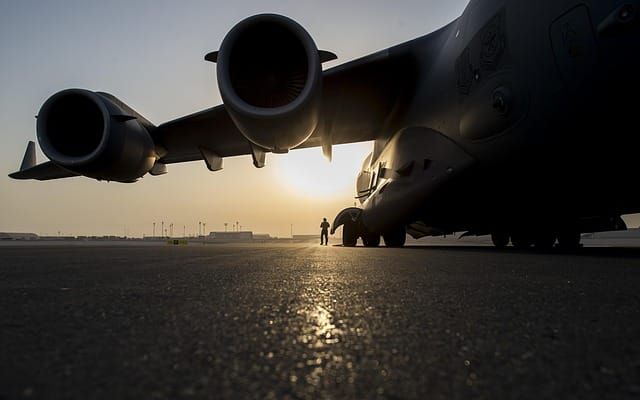
In the early hours of April 4, 2026, something significant happened across the skies of Europe. Residents near Sofia's Vasil Levski Airport reported a formation of US Air Force KC-135 Stratotanker aircraft departing with transponders switched off. Hours later, open-source flight trackers documented a mass movement of C-17 Globemaster transport aircraft crossing the Atlantic and staging across European hubs, heading toward the eastern Mediterranean and the Gulf.
This was not routine rotation. It was the largest visible airlift movement since the war against Iran began on February 28.
The timing is not coincidental. On April 3, Iran's semi-official Fars News Agency reported that Tehran had formally rejected a US proposal for a 48-hour ceasefire. The proposal had been delivered through an unnamed third country on April 2. Iran's response was not given in writing. It came through the continuation of attacks on the battlefield, including a strike targeting a US military depot on Kuwait's Bubiyan Island, a direct hit on allied territory that crossed a line of a different order than strikes on Iranian soil.
With diplomatic channels exhausted and ceasefire talks described by the Wall Street Journal as having hit a dead end, Washington appears to have made a decision. The question is what that decision actually means for the Strait of Hormuz, and by extension, for energy markets, inflation, and central bank policy across the developed world.
What 112 C-17s Mean
KC-135 tankers refuel aircraft that are already in the air. They have been staged in Sofia, Greece, Cyprus, and across the Gulf since February. Their presence says: we can sustain an air campaign indefinitely.
C-17s carry something different. Each one can transport a single M1 Abrams main battle tank, three Bradley infantry fighting vehicles, up to ten armored Humvees, or 102 paratroopers with full equipment. Retired Lieutenant Colonel Buzz Patterson, a former F-15 and F-16 pilot who carried the nuclear football for President Clinton, described the current deployment with unusual directness: 112 C-17s are in or on their way to the Middle East. That is a lot. Like Desert Storm a lot.
The US Air Force operates approximately 222 C-17s in total. Moving half the fleet to a single theater is not a logistics exercise. It is force projection at a scale not seen since the 2003 invasion of Iraq. Combined with three carrier strike groups now operating in the region, the 82nd Airborne Division already deployed, and Marine Expeditionary Units aboard the USS Tripoli, the picture is unambiguous: the United States is preparing for a ground component to this conflict.
The stated objective, as understood from diplomatic and military sources, is to force the reopening of the Strait of Hormuz. Iran has controlled the chokepoint effectively since the early weeks of the conflict, creating the most severe energy supply shock since 1973. The logic of a ground operation is straightforward: if air power alone cannot permanently suppress Iran's anti-ship missile and drone capabilities along the coast, boots on the ground can establish a defensive perimeter that secures passage.
The logic, however, breaks down when you look at a map.
The Geography of the Trap
The Strait of Hormuz is 33 kilometers wide at its narrowest point. Iran's coastline along the Strait and the Gulf of Oman stretches for hundreds of kilometers. The terrain is the Zagros Mountains meeting the Persian Gulf, a landscape of steep ridges, valleys, and caves that has been militarized specifically for this scenario over decades of Iranian strategic planning.
Iran's anti-access doctrine is built around one central insight: you do not need to win a conventional war to deny a strait. You need only to make the cost of transit prohibitive. A mobile rocket launcher can be repositioned in hours. A cave with a drone operator and a Shahed-136 is effectively invisible until the moment of launch. The Shahed costs between 20,000 and 50,000 dollars. A Patriot intercept costs 3 to 4 million dollars. Iran can sustain asymmetric attrition indefinitely at favorable exchange rates.
This is precisely the lesson of Yemen. The Houthis, a faction with a fraction of Iran's resources and sophistication, successfully threatened Red Sea shipping for over a year despite sustained US and allied naval and air operations against them. Every time a launch site was destroyed, another emerged. Iran is not the Houthis. Iran has a standing army, a deep industrial base, an established missile program, and a coastline it has studied intimately for exactly this contingency.
The critical geometric reality is this: to guarantee Hormuz transit, you would need to control the entire Iranian coastline bordering the Gulf of Oman and the Strait itself, which runs from Bandar Abbas south and east toward the Pakistani border. That requires either the permanent occupation of a significant portion of Iranian territory, or the complete destruction of Iran's capacity to wage any form of asymmetric warfare from that terrain. The first is politically impossible. The second has not been achieved against far less capable adversaries.
Even a successful initial ground operation, securing key coastal positions and destroying visible launch infrastructure, does not eliminate the threat. It disperses it. Underground facilities, pre-positioned mobile launchers, and decentralized drone networks can continue to threaten shipping from positions that are effectively impossible to fully map and neutralize. Any tanker transiting Hormuz under US escort would still be operating in contested airspace.
The Time Problem and Its Economic Consequences
Ground operations take time. The planning, staging, and execution of a ground campaign against prepared coastal defenses is measured in months, not days. The logistical footprint currently being assembled, with 112 C-17 sorties and three carrier groups, is consistent with an operation that will not achieve its objectives before summer at the earliest. A contested, drawn-out campaign could extend well beyond that.
During that entire period, the Strait of Hormuz remains functionally closed or severely restricted. Approximately 20 percent of global oil supply and close to 25 percent of the world's liquefied natural gas transit the Strait under normal conditions. Qatar's Ras Laffan terminal, which supplies a significant share of European LNG, suffered infrastructure damage earlier in the conflict. European gas prices remain at crisis levels. Brent crude is trading more than 40 percent above pre-conflict levels.
This is where the macro consequences become unavoidable. The supply shock is structural, not transient. It cannot be resolved by demand destruction or inventory drawdowns beyond a certain point. Central banks across the developed world now face exactly the dilemma that the Federal Reserve faced in 1973 and 1974 when it tightened monetary policy into the oil embargo, an episode I have written about previously as one of the defining policy mistakes of the 20th century.
The European Central Bank is already signaling rate increases in response to inflation figures that are being driven almost entirely by energy costs. This is precisely the wrong policy response to a supply shock. Raising rates when businesses and households are being squeezed by input costs they cannot control does not reduce inflation. It reduces demand, investment, and employment, compounding the external shock with internal damage. The ECB is not fighting demand-pull inflation. It is punishing European economies for a geopolitical event that monetary policy cannot resolve.
The Federal Reserve faces a similar dilemma, complicated by the dollar's role as the global reserve currency and the immediate fiscal implications of a sustained military campaign that is already, by every visible metric, among the most expensive in recent American history.
What Markets Are Not Pricing In
Markets have priced in a conflict. They have not priced in a prolonged, inconclusive one. The assumption embedded in current energy futures curves is that some form of resolution, whether a ceasefire, a negotiated settlement, or a decisive military outcome, occurs within a manageable timeframe. The rejection of the 48-hour ceasefire proposal and the scale of the current military buildup both challenge that assumption.
A ground operation that succeeds tactically but fails strategically, meaning it establishes a physical presence along the Hormuz coastline without actually suppressing the threat to shipping, is a scenario that could keep energy prices elevated for quarters rather than weeks. European industry, already under severe cost pressure, does not have that runway. Several major European economies are already in or approaching technical recession.
The macro transmission mechanism runs as follows. Sustained high energy costs compress corporate margins across manufacturing and transport. Real household incomes fall faster than nominal wages rise. Consumer spending contracts. Central banks, reading elevated headline inflation, maintain or increase rates. Credit conditions tighten further. Investment falls. The recessionary impulse deepens precisely as the inflation driver, the supply shock, remains stubbornly present.
This is stagflation. Not the theoretical version discussed in textbooks, but the operational version that destroyed the expansion of the early 1970s and required years of painful adjustment to unwind. The policy tools available to central banks are essentially useless against it, and the risk is that their deployment makes the outcome significantly worse.
The Bottom Line
The military logic driving the current buildup is understandable. Iran struck an allied base on Kuwaiti soil. A ceasefire was rejected. Air power alone has not resolved the Hormuz blockade. The pressure to escalate to ground operations is real and, within its own framework, coherent.
But the strategic logic does not survive contact with the terrain. The Zagros foothills and the Iranian coastline are not terrain that yields to conventional force projection, even at Desert Storm scale. The most likely outcome of a ground operation is not a secured strait. It is a prolonged, costly, and inconclusive campaign that keeps the Strait contested, keeps energy prices elevated, and keeps central banks facing choices they have no good tools to make.
The markets that understand this scenario have not yet fully priced it. The central banks that should understand it are currently doing the opposite of what the situation requires. And the geopolitical actors who could still choose a different path rejected a ceasefire this week through the continuation of attacks on the battlefield.
Watch the C-17 movements. Watch the Hormuz shipping data. And watch what the FED and ECB does next. The intersection of those three data points will define the macro environment for the remainder of 2026.
DISCLAIMER
This publication is for informational and analytical purposes only. Nothing herein constitutes financial advice or a recommendation to buy or sell any security or asset. The views expressed are those of the author based on publicly available information. Past performance is not indicative of future results.
Member discussion