The Picks and Shovels Play in the AI Gold Rush
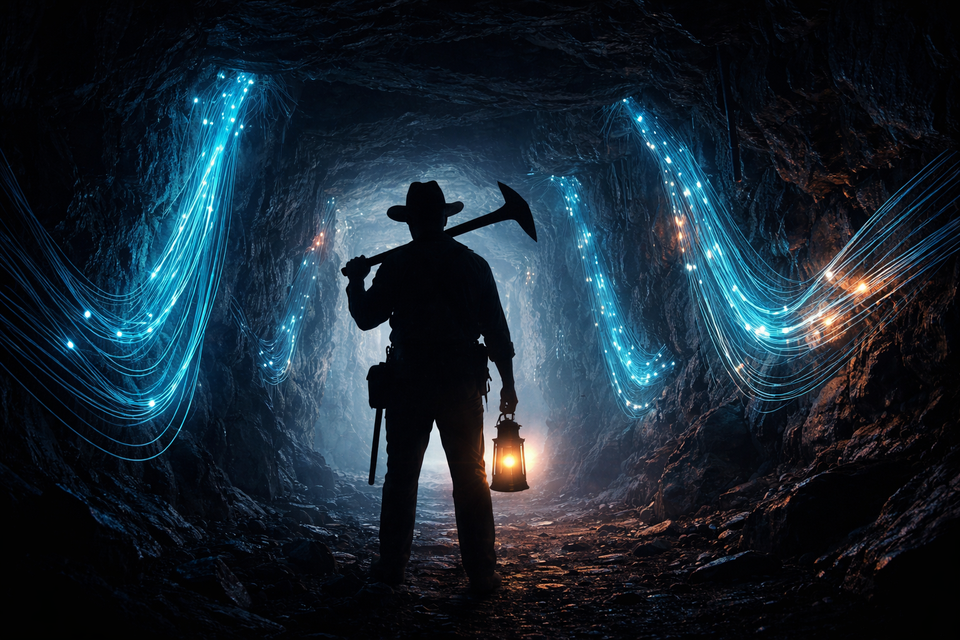
The Gold Rush Analogy
During the 1848 California Gold Rush, the most celebrated figures were the miners racing to strike it rich. But history has a different verdict about who actually made money. The merchants selling picks, shovels, denim pants, and provisions accumulated wealth far more reliably than those digging in the dirt. Levi Strauss did not mine a single ounce of gold. He sold the tools.
The AI revolution of the 2020s is the greatest gold rush in the history of technology. The miners are the model companies, the hyperscalers, the cloud providers. They are racing to build the most powerful AI systems ever conceived, spending hundreds of billions of dollars in the process. But beneath all of that compute lies a physical infrastructure that cannot be avoided: the optical fiber that moves data between GPUs, between racks, between data centers, and between continents.
AI-focused data centers require approximately 36 times more optical fiber than traditional CPU-based infrastructure. As GPU clusters scale toward 50,000 nodes and beyond, optical connectivity has become the binding constraint on AI performance. The network, not the chip, is now the bottleneck.
AI Optical Infrastructure: A Structural Supercycle
The numbers tell a structural story, not a cyclical one. Global data center fiber demand surged 75.9% year-on-year in 2025, and this segment is projected to account for 30% of total global fiber demand by 2027, up from just 5% in 2024. At least one major fiber manufacturer has already sold out its entire inventory through 2026. The United States alone will need to add 213 million additional fiber miles by 2029, more than doubling its current installed base.
This is not a story driven by geopolitics or temporary fiscal stimulus. It is driven by the fundamental physics of data transmission and the insatiable appetite of AI training and inference workloads for bandwidth. Unlike energy sector tailwinds that depend on sanctions regimes and commodity cycles, the optical fiber buildout is anchored in a multi-year capital expenditure commitment from the largest technology companies on earth. Meta alone has committed to spending $600 billion on AI infrastructure through 2028.
SUBSCRIBER CONTENT
The full company analysis continues below for paid subscribers.